
A Clinic Visit Does Not Automatically Make an Injury Recordable
An employee gets hurt at work and is sent to a clinic. Does that automatically mean the injury belongs on the OSHA 300 Log? No. Understanding OSHA first aid vs medical treatment requires employers to look at what actually happened, whether the case is work-related and new, what treatment was provided or recommended, and whether other OSHA recording criteria were triggered. Under OSHA’s 29 CFR 1904.7 general recording criteria, a work-related case may be recordable because of medical treatment beyond first aid, days away from work, restricted work or job transfer, loss of consciousness, death, or certain significant diagnoses.
That distinction matters for safety managers, HR teams, supervisors, and Louisiana employers coordinating workplace injury care. Gulf Coast Occupational Medicine provides employer-focused occupational health services, including injury care and related clinical services. Clear clinical documentation can help employers understand treatment and work-status recommendations, but the employer remains responsible for determining OSHA recordability under the applicable requirements.
OSHA First Aid vs Medical Treatment: Start With the Actual Care
OSHA defines medical treatment for recordkeeping purposes as management and care of a patient to combat disease or disorder. Importantly, OSHA excludes visits made solely for observation or counseling, diagnostic procedures such as X-rays and blood tests, and treatments on its specific first-aid list. This means an employee can be evaluated by a physician or occupational health provider without the visit itself becoming OSHA recordable treatment. Employers can review the complete definitions and first-aid list in OSHA’s general recording criteria.
OSHA also says the professional status of the person providing care does not change the classification. A treatment on the OSHA first aid treatment list remains first aid even when a physician or other licensed healthcare professional provides it. Conversely, treatment beyond the first-aid list can be medical treatment even if someone other than a physician provides it.
Common First Aid and Medical Treatment Examples
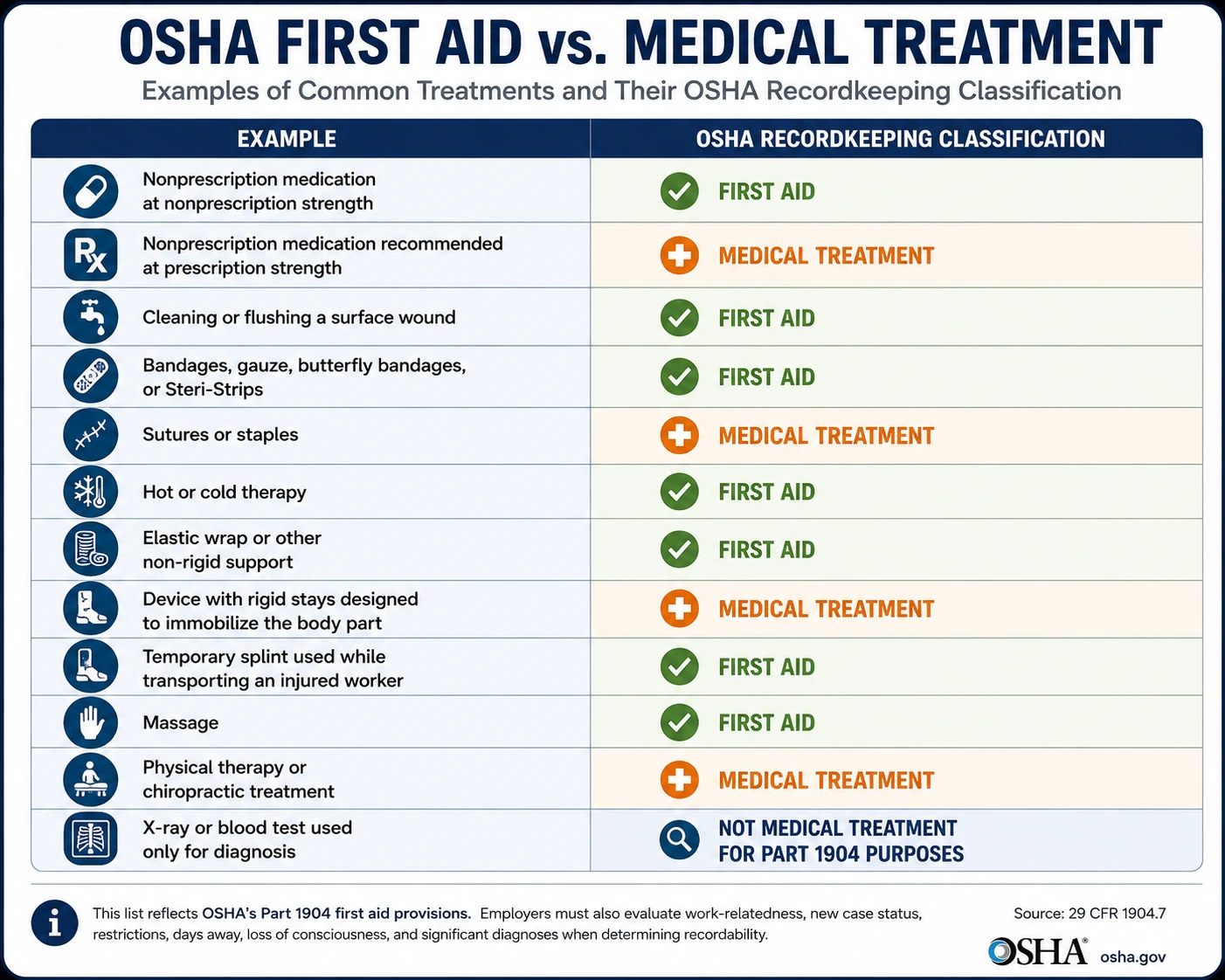
These classifications come directly from OSHA’s current first-aid provisions. OSHA’s recordkeeping guidance specifies treatments that qualify as first aid and distinguishes them from medical treatment beyond first aid.
Prescription medication used to treat an injury generally falls outside the first-aid list. OSHA also specifically states that recommending an otherwise nonprescription medication at prescription strength counts as medical treatment. Prescription medication used solely for a diagnostic procedure, however, is excluded from the medical-treatment definition for Part 1904 purposes.
Work-Relatedness and a New Case Come Before Recordability
Treatment alone is not the entire decision. Employers should first determine whether the condition is work-related. OSHA generally considers an injury or illness work-related when an event or exposure in the work environment caused or contributed to the condition or significantly aggravated a preexisting condition, unless a specific regulatory exception applies. Employers can review OSHA’s complete 29 CFR 1904.5 work-relatedness criteria when evaluating a case.
Employers must also determine whether the injury or illness is a new case. Under OSHA’s 29 CFR 1904.6 new-case criteria, a condition generally qualifies as new when the employee has not previously experienced a recorded condition of the same type affecting the same body part, or when a previous condition had completely resolved before a workplace event caused signs or symptoms to reappear.
This is why occupational injury recordability should not be decided solely from a clinic bill, diagnosis code, or the fact that an employee was evaluated.
Other OSHA 300 Log Criteria Can Make a Case Recordable
Even when treatment remains within first aid, another criterion may require the case to be recorded.
Restricted Work or Job Transfer
Restricted work occurs when a work-related injury or illness prevents an employee from performing one or more routine job functions or from working the full scheduled workday, or when a healthcare professional recommends such limitations. OSHA defines routine functions as activities the employee regularly performs at least once per week. Restrictions that apply only on the day of injury do not, by themselves, create a restricted-work case.
For example, an employee who receives only an elastic wrap might have received first aid. But if a clinician also recommends that the employee avoid a routine lifting function on subsequent days, the restriction may independently make the case recordable.
Days Away From Work
If a healthcare professional recommends days away because of a work-related injury or illness, OSHA requires covered employers to record those days even if the employee chooses to come to work anyway.
Loss of Consciousness and Significant Diagnoses
A work-related loss of consciousness is recordable regardless of duration. OSHA also identifies certain significant diagnoses, including fractured or cracked bones, punctured eardrums, cancer, and chronic irreversible diseases, as recordable even when other general criteria are absent.
Employers reviewing the OSHA 300 log criteria therefore need the complete clinical and work-status picture, not simply an answer to whether stitches or medication were provided.
Need Clearer Workplace Injury Documentation?
Gulf Coast Occupational Medicine lists occupational injury care among its current occupational health services. Employers can also review GCOM’s workplace injury management guidance when developing procedures for evaluation, documentation, work status, and follow-up.
A Hand Injury at a Baton Rouge Facility
An employee at a Baton Rouge manufacturing facility receives a shallow cut while performing assigned work.
At the occupational clinic, the wound is cleaned and covered with Steri-Strips. The employee is advised to use an over-the-counter pain reliever at normal nonprescription strength and returns to normal duties without restriction.
Those treatments appear on OSHA’s first-aid list. Assuming the case does not meet another recording criterion, the fact that the employee visited a medical clinic does not by itself make the injury recordable.
Now change one fact. Suppose the wound requires sutures, or the clinician recommends a restriction that prevents the employee from performing a routine job function after the injury day. The case may then meet an OSHA recording criterion because of medical treatment beyond first aid or restricted work.
The lesson is not to influence treatment to achieve a preferred recordkeeping outcome. Appropriate patient care comes first. Employers should document what was medically provided and recommended, then evaluate the facts under OSHA’s recordkeeping criteria.
Documentation Checklist for Occupational Injury Recordability
When reviewing OSHA first aid vs medical treatment, employers should collect enough factual information to make a defensible recordkeeping decision.
- Confirm the date, time, location, and circumstances of the incident.
- Determine whether the injury or illness is work-related under 29 CFR 1904.5.
- Determine whether it is a new case under 29 CFR 1904.6.
- Document the exact treatment provided and recommended.
- Record medication name, strength, and whether it was prescription or nonprescription when relevant.
- Identify the wound-closing method or support device used.
- Document diagnostic testing separately from treatment.
- Obtain clear written work-status instructions.
- Compare restrictions with the employee’s routine job functions.
- Determine whether days away, job transfer, or restricted work were recommended.
- Check for loss of consciousness or a significant diagnosed injury or illness.
- Review whether any separate OSHA reporting requirement applies.
- Document the employer’s final recordability determination and the information used to make it.
For employers that maintain OSHA logs, GCOM’s existing OSHA recordkeeping guide provides broader information about Forms 300, 301, and 300A. The first-aid versus medical-treatment analysis should function as a narrower supporting resource rather than replacing that broader recordkeeping guidance.
Recordable and Reportable Do Not Mean the Same Thing
An injury can be recordable without being immediately reportable to OSHA. Under OSHA’s 29 CFR 1904.39 severe-injury reporting requirements, employers must report a work-related fatality within eight hours and a work-related inpatient hospitalization, amputation, or loss of an eye within 24 hours, subject to the regulation’s timing and applicability provisions. Those reporting requirements are separate from the ordinary OSHA 300 Log analysis.
That distinction is another reason employers should avoid using the terms “recordable” and “reportable” interchangeably.
Build a Clearer Workplace Injury Recordkeeping Process
The practical difference between OSHA first aid vs medical treatment comes down to the treatment actually provided or recommended, together with work-relatedness, new-case status, work restrictions, days away, loss of consciousness, and significant diagnoses. A clinic visit alone is not the deciding factor.
Gulf Coast Occupational Medicine provides employer-focused occupational health and workplace injury services. Employers can also use GCOM’s Louisiana occupational medicine locations when building a consistent injury-response process across multiple worksites. The current locations page lists Baton Rouge, Gonzales, Geismar, Addis, Walker, Reserve, and an appointment-only Dow Chemical contractor location in Plaquemine.
Call Gulf Coast Occupational Medicine at (225) 753-7233 to discuss workplace injury-care procedures and occupational health support for your workforce. The number is currently listed on GCOM’s Locations page.
Frequently Asked Questions
Does sending an employee to a doctor make an injury OSHA recordable?
No. A visit solely for observation or counseling is not medical treatment for OSHA recordkeeping purposes. Diagnostic procedures such as X-rays and blood tests also do not constitute medical treatment by themselves. Other recording criteria can still make the case recordable. See OSHA’s general recording criteria for the complete requirements.
Are stitches considered first aid by OSHA?
No. OSHA includes bandages, gauze, butterfly bandages, and Steri-Strips on its first-aid list, but sutures, staples, and other wound-closing devices fall outside that first-aid category.
Is physical therapy OSHA recordable treatment?
Physical therapy is considered medical treatment rather than first aid under OSHA’s recordkeeping rule. Massage, by contrast, appears on the first-aid list. For a work-related new case, physical therapy can therefore trigger recordability based on medical treatment beyond first aid.
Does light duty automatically make an injury recordable?
Not simply because someone uses the words “light duty.” OSHA looks at whether the restriction prevents the employee from performing one or more routine job functions or from working the full workday. Employers can seek clarification from the healthcare professional when restrictions are unclear.
