
Finding a Workplace Risk Is Only the First Step
A workplace risk assessment may identify noise, respiratory hazards, chemical exposures, physically demanding jobs, safety-sensitive duties, or other conditions that deserve attention. The next question for an employer is not simply, “Which test should we order?” It is, “What occupational-health action actually matches this employee’s job, exposure, and program requirements?”
That is where Gulf Coast Occupational Medicine can support the employer side of workforce health. GCOM provides occupational and industrial medicine services for employers managing physical examinations, medical surveillance, respiratory programs, hearing testing, drug and alcohol testing, workplace injuries, and other job-related health requirements. The employer, however, remains responsible for identifying workplace hazards, determining which standards and policies apply, and controlling those hazards.
Where Occupational Health Fits Into a Workplace Risk Assessment
OSHA describes hazard identification and assessment as an ongoing employer process that includes reviewing workplace information, inspecting work areas, investigating incidents, identifying health hazards, and evaluating who may be exposed.
Occupational medicine comes into the process after the employer understands enough about the job and hazard to determine whether employees need medical evaluation, screening, surveillance, testing, or follow-up.
A useful workflow is:
Workplace hazard identified → affected job roles identified → applicable requirements reviewed → occupational-health service determined → employees scheduled → results or status routed appropriately → follow-up tracked
Medical testing should support the risk-management process. It should not replace exposure assessment, engineering controls, work practices, training, PPE selection, or other employer safety responsibilities.
Match the Occupational Health Service to the Risk
Different workplace findings can lead to different questions.
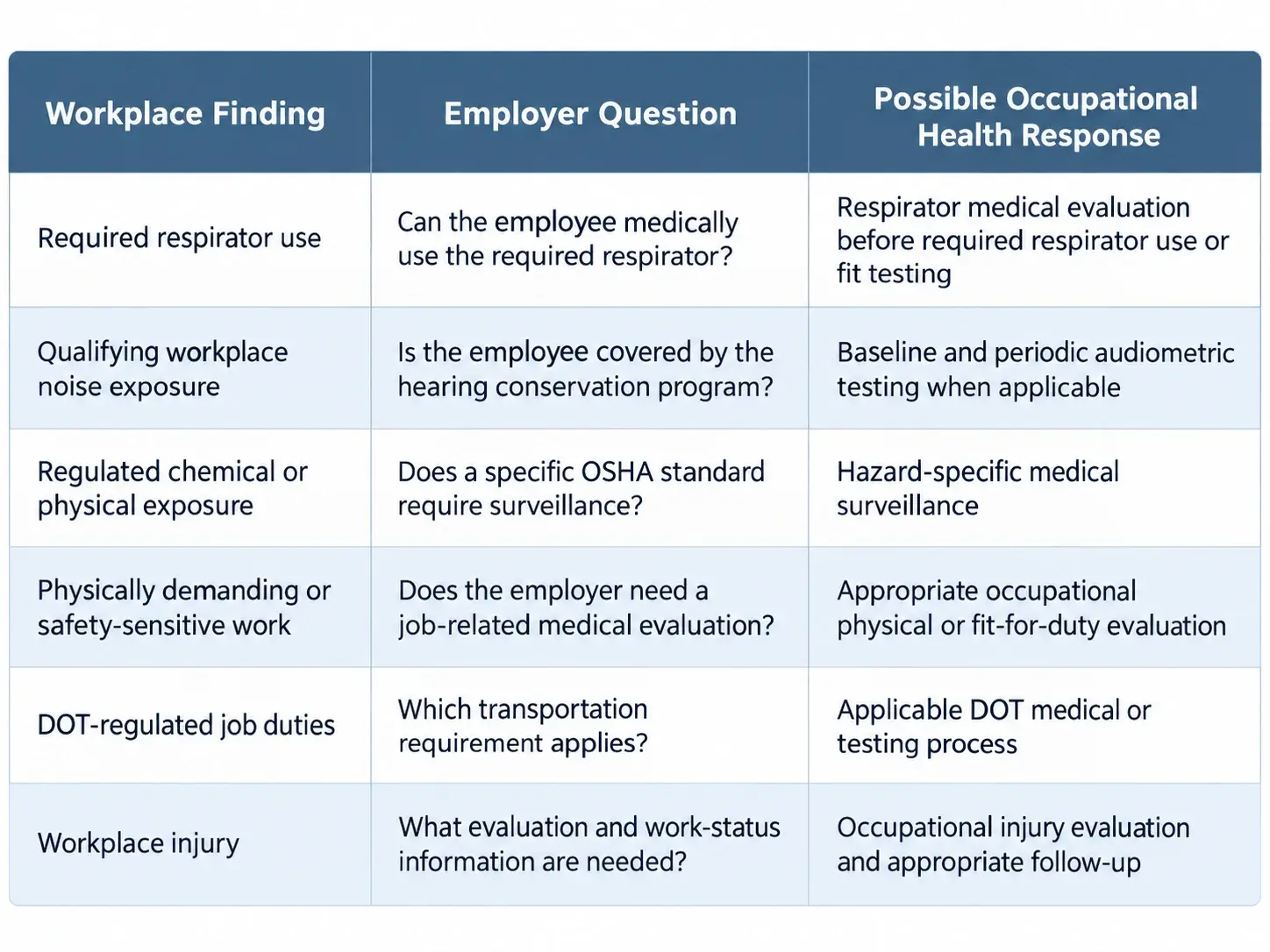
This distinction matters because employee occupational health testing should be connected to a defined job requirement or program rather than applied uniformly to the entire workforce.
OSHA’s medical surveillance resources reinforce this point. Medical screening and surveillance requirements are tied to specific standards and workplace hazards, not one universal annual examination. OSHA Medical Screening and Surveillance Requirements Guide
Respirator Use Is a Good Example
An employer identifies airborne hazards and determines that certain employees must wear respirators.
That finding creates a sequence of responsibilities. Under OSHA’s respiratory protection standard, the employer must provide a medical evaluation to determine the employee’s ability to use the respirator before the employee is fit tested or required to use it in the workplace. OSHA Respiratory Protection Standard
The occupational-health provider performs the medical component. The employer still manages the workplace respiratory-protection program, identifies which workers require respirators, and ensures that the correct equipment and procedures are used.
GCOM’s physical exams and health surveillance services include regulatory examinations, health-surveillance testing, spirometry, fit testing, audiometry, laboratory services, and related occupational-health evaluations.
Move From “We Need Testing” to a Defined Program
If your safety assessment has already identified affected workers, organize the job categories, hazards, required programs, testing dates, and unresolved cases before scheduling.
Gulf Coast Occupational Medicine can help employers coordinate the occupational-health portion of that plan. Starting with a defined workforce need makes it easier to determine which employees should receive which services without turning testing into a one-size-fits-all process.
Noise Exposure Shows Why Testing Should Follow the Hazard
A noisy facility does not automatically mean every employee needs an audiogram.
Under OSHA’s general-industry noise standard, employers must make audiometric testing available to employees whose exposures equal or exceed an eight-hour time-weighted average of 85 dBA. The standard includes baseline and annual audiogram requirements for covered employees. OSHA Occupational Noise Exposure Standard
This is another example of why employer medical surveillance should begin with exposure information and job classification.
A maintenance technician working in a high-noise production area may fall into a different occupational-health workflow than an administrative employee working in an office at the same facility.
Different Industries Can Require Different Testing Workflows
GCOM currently serves employers across industries including industrial construction and maintenance, oil and gas, petrochemical and refining, manufacturing, transportation and logistics, and government or municipal operations.
The same occupational-health question can look different across those workplaces.
A construction contractor may be managing respirator evaluations and project mobilization. A manufacturing employer may be coordinating hearing conservation and medical surveillance. A transportation company may have DOT-regulated employees alongside non-DOT employees. A refinery contractor may need several different surveillance protocols within the same project roster.
The correct response is not to create one testing package for everyone. It is to map employees to the requirements that actually apply.
Employers building a broader screening process can also review GCOM’s employee health screening program guidance for additional workforce-planning context.
One Employer, Four Job Groups
A Louisiana industrial employer performs a workplace risk review before expanding operations.
The employer identifies four groups:
- Production employees exposed to qualifying noise levels
- Maintenance employees required to wear respirators
- Commercial drivers performing regulated transportation duties
- Administrative employees without the same occupational exposures
The company does not send all four groups for identical testing.
The safety team maps the noise-exposed group to the hearing program, confirms respiratory requirements for the maintenance group, reviews the appropriate transportation requirements for covered drivers, and avoids assigning unnecessary occupational testing to administrative workers solely because they work for the same company.
The employer then sends the occupational-health provider a defined roster instead of a vague request for “employee physicals.”
That creates a clearer starting point for both the employer and the provider.
Clinic or Mobile Testing?
Once the required services are defined, employers can decide how they should be delivered.
Clinic-based testing may be practical for individual employees, specialized follow-up, or smaller groups. Mobile occupational health may make sense when larger crews, remote worksites, project schedules, or multiple shifts would make individual clinic visits difficult.
GCOM currently provides clinic-based services and mobile medical units for employer testing and screening. GCOM occupational health services
The delivery model should come after the service requirement is understood. Bringing testing on site is not a reason to give employees services they do not need.
What to Have Ready Before Contacting an Occupational Health Provider
Employers can make scheduling more productive by organizing:
- Employee or contractor count
- Job classifications
- Known workplace hazards
- Exposure-monitoring information when available
- Applicable OSHA, DOT, company, or project requirements
- Requested examinations or testing
- Current surveillance or clearance dates
- Work locations
- Shift schedules
- Project or mobilization dates
- Employees requiring follow-up
- Employer contact responsible for results or status reporting
- Preference for clinic or mobile delivery
Having this information available helps the provider understand the scope of the workforce need before appointments or mobile services are scheduled.
Turn Workplace Risk Findings Into a Clear Testing Plan
A workplace risk assessment should lead to action, but that action is not automatically a medical test for every employee. Employers should first identify the hazard, affected jobs, exposure conditions, applicable regulations, and company requirements. Occupational-health testing can then be matched to the employees who actually need it.
Gulf Coast Occupational Medicine supports employers with occupational physicals, medical surveillance, workplace health screening, respiratory and hearing programs, and other industrial occupational medicine services. If your organization has already identified workforce risks and needs help coordinating the health-testing portion of the plan, have your job classifications, hazards, workforce size, work locations, and required programs ready.
Call Gulf Coast Occupational Medicine at (225) 753-7233 or use the GCOM contact page to discuss the occupational-health testing needs of your workforce.
Frequently Asked Questions
Does Gulf Coast Occupational Medicine perform workplace risk assessments?
GCOM can support the occupational-health side of a workplace risk-management program through examinations, surveillance, testing, injury care, and related services. Employers remain responsible for identifying workplace hazards and determining which regulatory and company requirements apply.
Does every employee need occupational health testing after a risk assessment?
No. Testing should be connected to the employee’s actual job duties, exposures, regulatory requirements, or employer program. Different groups within the same company may require different services.
What is the difference between workplace screening and medical surveillance?
Screening generally evaluates an individual for a particular health concern or job-related purpose. Medical surveillance is a broader process that can use individual or group health information to monitor workplace hazards and identify trends that may require prevention or follow-up.
Can Gulf Coast Occupational Medicine provide testing at the worksite?
Yes. GCOM currently lists mobile and on-site occupational health services in addition to its Louisiana clinic network. Employers should discuss workforce size, required services, site access, schedules, and follow-up needs before deployment.
