
Know Which DOT Rule Applies Before Ordering an Alcohol Test
Employers managing commercial drivers and other transportation safety-sensitive workers need to understand both DOT alcohol testing requirements and the rule that applies to their specific workforce. 49 CFR Part 40 establishes the procedures used for DOT drug and alcohol testing, including who may conduct tests, approved forms and devices, screening and confirmation procedures, refusals, confidentiality, and reporting. The individual DOT agency, such as FMCSA, determines which employees are covered and when testing is required.
For Louisiana transportation and industrial employers, Gulf Coast Occupational Medicine currently provides occupational health services that include drug and alcohol testing through clinic-based and mobile/on-site services. Employers remain responsible for determining whether a test is DOT-regulated, selecting the correct testing reason, and following their applicable agency regulations.
This article uses FMCSA-regulated commercial drivers as the primary example. Other DOT agencies may have different testing circumstances or consequences, so employers should verify the rule governing their employees.
How a DOT Alcohol Test Works Under Part 40
A DOT alcohol test is not simply an informal breath test. Part 40 establishes controlled procedures intended to protect the integrity and confidentiality of the test.
A Screening Test Technician, or STT, may perform alcohol screening functions for which the technician is qualified. A qualified Breath Alcohol Technician, or BAT, may conduct screening tests and is responsible for breath alcohol confirmation testing. DOT requires specific qualification training for BATs and STTs.
Every DOT alcohol test must use the DOT Alcohol Testing Form, or ATF. Employers cannot use that federal form for a non-DOT test, and a non-DOT form generally should not be substituted for a DOT test. This separation is important when a company operates both regulated and company-policy testing programs.
Screening and Confirmation Tests
The first step is an alcohol screening test using an approved device. If the result is below 0.02, the BAT or STT completes the applicable ATF steps and reports the result confidentially to the designated employer representative.
If the screening result is 0.02 or higher, a DOT alcohol confirmation test is required. Before confirmation, there is a waiting period of at least 15 minutes. The confirmation should begin as soon as possible after that period, generally no more than 30 minutes after completion of screening.
Confirmation testing must use an approved evidential breath testing device, or EBT, meeting Part 40 requirements.
DOT Alcohol Testing Process Map
Employer identifies a valid DOT testing reason
↓
Confirm employee and testing event fall under the applicable DOT agency rule
↓
BAT or STT verifies identity and completes the DOT ATF process
↓
Alcohol screening test
↓
Result below 0.02 → Result transmitted confidentially to DER
↓
Result 0.02 or higher → Confirmation test required
↓
At least 15-minute waiting period
↓
BAT conducts confirmation using an approved EBT
↓
Final confirmation result transmitted to DER
↓
Employer takes action required by Part 40 and the applicable DOT agency regulation
Employers planning clinic-based or job-site testing can review GCOM’s current occupational health services and discuss which collection arrangement fits their workforce. GCOM’s service page currently lists alcohol testing and drug testing among its occupational health capabilities.
When FMCSA Alcohol Testing May Occur
FMCSA’s testing requirements under 49 CFR Part 382 provide a useful example of why employers should not treat every alcohol test the same.
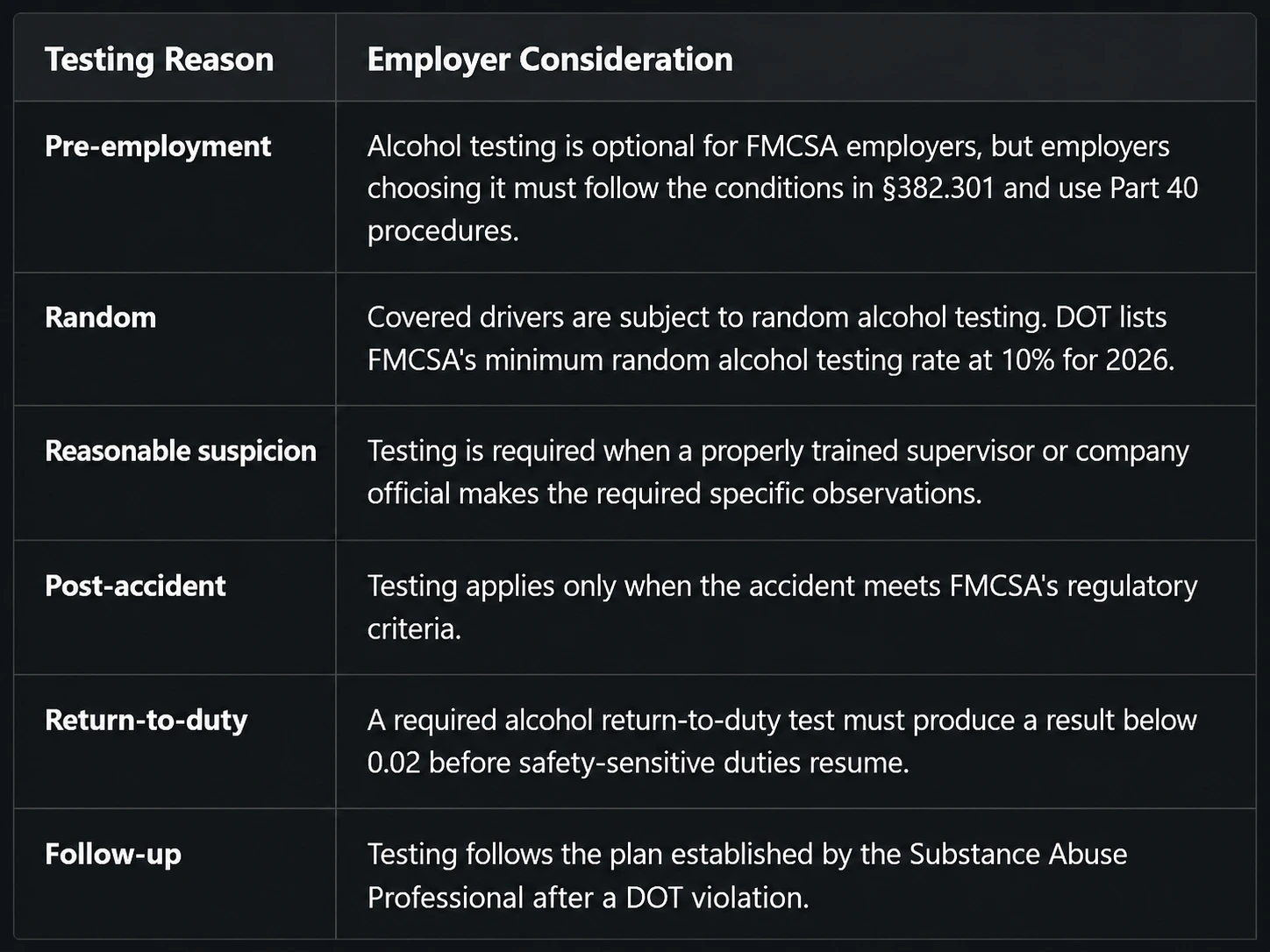
FMCSA employers may choose to conduct pre-employment alcohol testing, but if they do, the program must apply consistently to covered employees and testing must occur after a contingent offer and before the first performance of safety-sensitive functions.
For random testing, DOT’s published 2026 FMCSA random alcohol rate is 10% of the average number of covered driver positions. Alcohol random tests must be conducted just before, during, or just after the employee performs a safety-sensitive function.
Post-Accident Timing Requires Advance Planning
FMCSA post-accident alcohol testing is particularly time-sensitive. Under 49 CFR 382.303, qualifying crashes can require alcohol testing based on fatalities or, for certain nonfatal crashes, immediate medical treatment or tow-away damage combined with a qualifying citation.
When a required alcohol test has not been completed within two hours, the employer must document why it was not promptly administered. Attempts stop after eight hours, with the employer documenting why testing could not be completed. A driver subject to the post-accident requirement also must not use alcohol for eight hours following the accident or until the test occurs, whichever comes first.
Employers needing a deeper accident decision guide can review GCOM’s DOT post-accident testing resource.
What Alcohol Test Results Mean for the Employer
A screening result of 0.02 or higher is not the final point in the process. The employer must confirm the result before applying it.
Under 49 CFR 40.23, an employer receiving a confirmation result of 0.04 or higher must immediately remove the employee from safety-sensitive functions. The employee cannot resume those duties until the required return-to-duty process is completed.
A confirmation result of 0.02 through 0.039 also requires temporary removal under the applicable DOT agency rule. For FMCSA drivers, the employee cannot perform safety-sensitive functions until the next regularly scheduled duty period and at least 24 hours have elapsed.
Return-to-duty testing is different from ordinary workplace testing. After the required Substance Abuse Professional process, the return-to-duty alcohol test must be below 0.02 before an employer may return the employee to safety-sensitive functions.
For follow-up testing, the SAP determines the type and frequency of testing. Part 40 requires at least six unannounced follow-up tests during the first 12 months of safety-sensitive duty, with additional testing potentially continuing beyond the first year.
Insufficient Breath and Refusals Need a Defined Procedure
An employee who initially cannot provide enough breath has not automatically refused a test.
The BAT or STT must provide another opportunity according to Part 40 procedures. If the employee still cannot produce sufficient breath, the employer must direct the employee to an appropriate physician evaluation within five days. A documented medical explanation can result in cancellation of the test. If the required evaluation finds no adequate medical basis for the insufficient breath, the situation is treated as a refusal.
Other actions can also constitute a refusal, including failing to remain at the testing site after the testing process has begun, failing to cooperate, refusing required attempts, or refusing to sign the required certification portion of the ATF.
Keep DOT and Non-DOT Testing Separate
Part 40 requires DOT and non-DOT tests to remain separate. Employers should not use the DOT ATF for company-policy alcohol testing or label a non-DOT test as a federal test merely because the employee performs safety-sensitive work.
A practical employer checklist includes:
- Confirm which DOT agency regulates the employee.
- Document the correct testing reason.
- Identify the DER who will receive results.
- Confirm that qualified BAT/STT personnel are available.
- Use the DOT ATF only for DOT testing.
- Keep DOT and non-DOT records clearly separated.
- Verify that approved alcohol-testing equipment is being used.
- Plan access for random, reasonable-suspicion, and post-accident needs.
- Document post-accident testing delays when required.
- Maintain confidentiality of individual test information.
- Confirm current clinic or mobile availability before an urgent testing need occurs.
Part 40 generally prohibits releasing individual DOT test results or medical information to third parties without the employee’s specific written consent unless another provision authorizes or requires disclosure. Confirmation results are transmitted to the DER using confidential procedures.
GCOM currently lists mobile and on-site occupational health services that include breath alcohol collection. Employers should confirm current availability, location, timing, and DOT-specific testing requirements when arranging service.
A Louisiana Transportation Employer
A Baton Rouge transportation employer manages both CDL drivers covered by FMCSA and warehouse employees covered only by company policy.
A CDL driver is selected for a DOT random alcohol test. The employer identifies the test as FMCSA-regulated, sends the correct information to the testing provider, and keeps the DOT process separate from its warehouse testing program.
If the screening result is below 0.02, it is reported to the DER under the Part 40 process. If the screening result is 0.02 or higher, confirmation testing follows before the employer determines the required action.
This separation prevents a common administrative problem: mixing a federal testing event with a company-policy test that follows different rules.
Build a More Reliable DOT Alcohol Testing Process
Understanding DOT alcohol testing requirements means knowing more than when to order a test. Employers need the correct testing authority, trained personnel, approved procedures, reliable DER communication, proper documentation, and a clear distinction between DOT and non-DOT programs.
Gulf Coast Occupational Medicine currently provides alcohol testing, drug testing, occupational health services, and mobile/on-site support for employers. Its Louisiana locations include Baton Rouge, Gonzales, Geismar, Addis, Walker, Reserve, and an appointment-only contractor location in Plaquemine.
Call Gulf Coast Occupational Medicine at (225) 753-7233 to discuss workplace drug and alcohol testing services, clinic-based testing, or mobile occupational health support for your workforce. The number is currently listed on GCOM’s contact and locations pages.
Frequently Asked Questions
What alcohol concentration requires a DOT confirmation test?
A screening alcohol concentration of 0.02 or higher requires a confirmation test under Part 40. A screening result below 0.02 is reported without proceeding to confirmation.
Is pre-employment alcohol testing required for FMCSA drivers?
No. FMCSA permits employers to conduct pre-employment alcohol testing but does not require it. Employers that elect to test must comply with the conditions in §382.301 and Part 40 procedures.
What happens after a DOT alcohol result of 0.04 or higher?
The employer must immediately remove the employee from safety-sensitive functions. The employee must satisfy the applicable DOT return-to-duty requirements before resuming covered safety-sensitive work.
Can DOT and non-DOT alcohol tests use the same form?
No. DOT regulations require the DOT Alcohol Testing Form for DOT tests and prohibit employers from using it for non-DOT testing programs.
