
Not Every Commercial Vehicle Crash Requires a DOT Test
A crash involving a CDL driver can create immediate pressure for fleet and safety managers. The key point is that DOT post-accident drug testing is not automatically required after every commercial motor vehicle crash. Under FMCSA rules, the decision depends on the type of accident, whether there was a fatality, whether someone received immediate medical treatment away from the scene, whether a vehicle had disabling damage requiring tow-away, and, in certain nonfatal crashes, whether the CMV driver received a qualifying moving-traffic citation.
For Louisiana transportation and logistics employers, having this process established before an accident can prevent confusion when the clock is already running. Gulf Coast Occupational Medicine provides employer-focused occupational health services, including drug and alcohol testing, through Louisiana clinics and mobile/on-site capabilities. Employers remain responsible for determining whether federal testing applies.
This article provides general compliance information and is not individualized legal advice.
FMCSA Post-Accident Testing: The Three Main Triggers
The controlling federal rule is 49 CFR 382.303. It applies to qualifying accidents involving a commercial motor vehicle operating on a public road in commerce. For a surviving driver who was performing safety-sensitive functions with respect to the vehicle, the basic decision framework is:
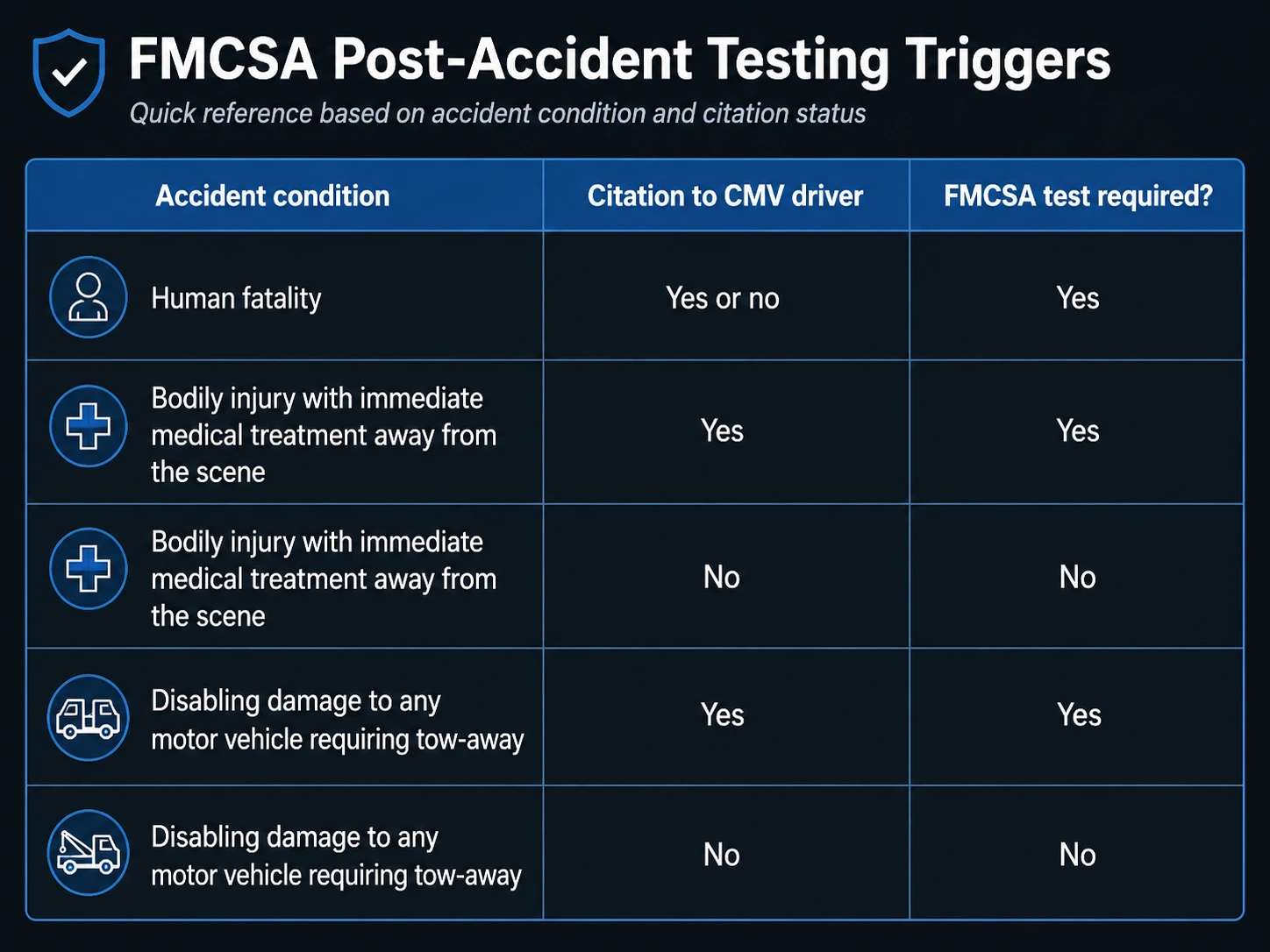
The FMCSA testing chart uses this framework. A fatality triggers testing regardless of citation. For the injury and tow-away categories, the citation matters.
There is an important timing detail in 49 CFR 382.303. For alcohol testing after a nonfatal qualifying crash, the moving-traffic citation must be received within 8 hours. For controlled-substance testing, the citation window is 32 hours. This distinction can be missed in a simplified list of post-accident testing requirements.
DOT Post-Accident Drug Testing and Alcohol Testing Timeline
When DOT post-accident drug testing or alcohol testing is required, FMCSA directs employers to act as soon as practicable.
For alcohol testing, if the test has not been completed within 2 hours, the employer must create and maintain a record explaining why it was not promptly administered. If it is still not completed within 8 hours, the employer must stop attempts and maintain the required record.
For controlled substances, the employer must stop attempts if the required test has not been administered within 32 hours and document why. These are regulatory limits, not suggested appointment times.
A driver required to complete a post-accident alcohol test also may not use alcohol for 8 hours after the accident, or until the test occurs, whichever comes first. Necessary medical attention should never be delayed for testing.
If your fleet needs a clearer response process, Gulf Coast Occupational Medicine can help you plan access to occupational health services and testing resources. The employer remains responsible for its DOT program and testing decisions.
DOT Testing and Company Policy Are Not the Same
A company-required post-crash test is not automatically a federal DOT test. If a crash does not meet FMCSA criteria, an employer may still have a separate non-DOT testing requirement under its written policy, customer contract, or applicable law.
DOT and non-DOT testing must remain separate. 49 CFR 40.13 states that DOT tests must be completely separate from non-DOT tests. Employers should not label a company-policy test as DOT testing when the driver or event is outside federal authority, and DOT forms should not be used for non-DOT testing.
For any CDL accident drug test decision, first determine whether FMCSA authority applies. If federal criteria are not met, separately review the company’s non-DOT policy and applicable requirements. This is one of the most important post-accident testing requirements for fleets with both regulated and non-regulated employees.
What If the Driver Is Unavailable?
A driver subject to FMCSA post-accident testing must remain readily available. Failure to remain available may be treated by the employer as a refusal in appropriate circumstances. However, 49 CFR 382.303 does not require delaying necessary medical attention or prevent a driver from leaving the scene to obtain emergency care or assistance.
Employers should document barriers such as emergency treatment, law-enforcement activity, remote location, or collection-site availability. If required alcohol testing is delayed beyond 2 hours, or a required test cannot be completed within its maximum window, the regulation requires records explaining why.
FMCSA guidance also addresses a later fatality. If an injured person dies while the applicable 8-hour alcohol or 32-hour controlled-substance window is still open, the employer must attempt the required test until that window expires.
Hypothetical Louisiana Fleet Scenario
Hypothetical example: A Baton Rouge fleet driver is operating a CMV on a public road when a collision occurs. No one dies, but another person is transported from the scene for immediate medical treatment. The CMV driver receives a moving-traffic citation at the scene.
Because the crash includes immediate medical treatment away from the scene and a qualifying citation, the employer would need the required DOT alcohol and controlled-substance tests. If the alcohol test is not completed within 2 hours because the driver is still dealing with police and necessary medical evaluation, the employer should document the reason and continue appropriate efforts. Alcohol-test attempts stop after 8 hours; the controlled-substance window extends to 32 hours.
If the same crash occurred without a qualifying citation, the nonfatal injury alone would not trigger DOT post-accident drug testing under § 382.303. The employer could still need to review its non-DOT policy before deciding whether a separate CDL accident drug test is required.
Build an After-Hours Collection Plan Before the Crash
Fleet managers should identify who makes the testing decision and give drivers required post-accident instructions before they operate a CMV. A practical decision record should capture:
- Accident date and exact time
- Whether the CMV was operating on a public road in commerce
- Fatality, immediate treatment away from the scene, or tow-away damage
- Whether and when the CMV driver received a moving-traffic citation
- When alcohol and controlled-substance testing was ordered and attempted
- Why a required test was delayed or could not be completed
FMCSA requires employers to provide drivers with necessary post-accident information, procedures, and instructions before the driver operates a commercial motor vehicle. The U.S. Department of Transportation’s employer resources also provide current Part 40 and FMCSA materials for covered employers.
Gulf Coast Occupational Medicine currently lists multiple Louisiana occupational medicine locations and states that after-hours call-out services are available as needed. Its mobile and on-site services also include drug and alcohol testing. Employers should confirm current availability for the specific time, location, and testing need.
Create a Faster, More Consistent Post-Accident Response
A strong DOT post-accident drug testing process starts with the regulation, not assumptions. Review the crash against 49 CFR 382.303, separate federal and company-policy testing, track the DOT alcohol testing timeline, and document delays or unsuccessful attempts.
Gulf Coast Occupational Medicine supports Louisiana transportation and logistics employers with workplace drug and alcohol testing and broader occupational health services. Call (225) 753-7233 to discuss post-accident testing access, employer testing needs, or clinic-based and on-site occupational health support.
Frequently Asked Questions
Does every CDL accident require a DOT drug test?
No. FMCSA post-accident testing is required after a fatality regardless of citation. For qualifying nonfatal injury or tow-away crashes, the CMV driver generally must receive a moving-traffic citation within the applicable regulatory window before federal testing is triggered.
How long does an employer have for DOT post-accident drug testing?
A required controlled-substance test must be attempted as soon as practicable. If it is not administered within 32 hours after the accident, the employer must stop attempts and maintain a record explaining why it was not completed.
What is the DOT alcohol testing timeline after an accident?
Testing should occur as soon as practicable. If a required alcohol test is not administered within 2 hours, the employer must document the reason. If it is not completed within 8 hours, attempts must stop, and the employer must maintain the required record.
Can a company require testing when FMCSA does not?
Potentially, yes, depending on the employer’s written non-DOT policy and applicable legal or contractual requirements. DOT and non-DOT tests must remain completely separate under 49 CFR 40.13.
