
Silica Surveillance Starts With the Correct OSHA Trigger
Cutting, sawing, grinding, drilling, and crushing materials such as concrete, stone, brick, block, and mortar can create respirable crystalline silica. For employers managing construction, manufacturing, maintenance, petrochemical, and other industrial work, identifying the exposure is only the first step. Employers must also determine whether OSHA’s silica medical surveillance requirements apply to specific employees.
The trigger is not identical in every workplace. Construction employers follow 29 CFR 1926.1153, while most covered general-industry operations follow 29 CFR 1910.1053. Gulf Coast Occupational Medicine supports industrial employers with occupational health services that currently include silica-related screenings, pulmonary function testing, X-ray services, and mobile/on-site capabilities.
This article provides general regulatory information and does not replace an employer’s site-specific exposure assessment, OSHA obligations, or professional legal and safety guidance.
When Does OSHA Require Silica Medical Surveillance?
One of the most important distinctions is whether the employee is performing construction work or is covered by the general-industry standard.
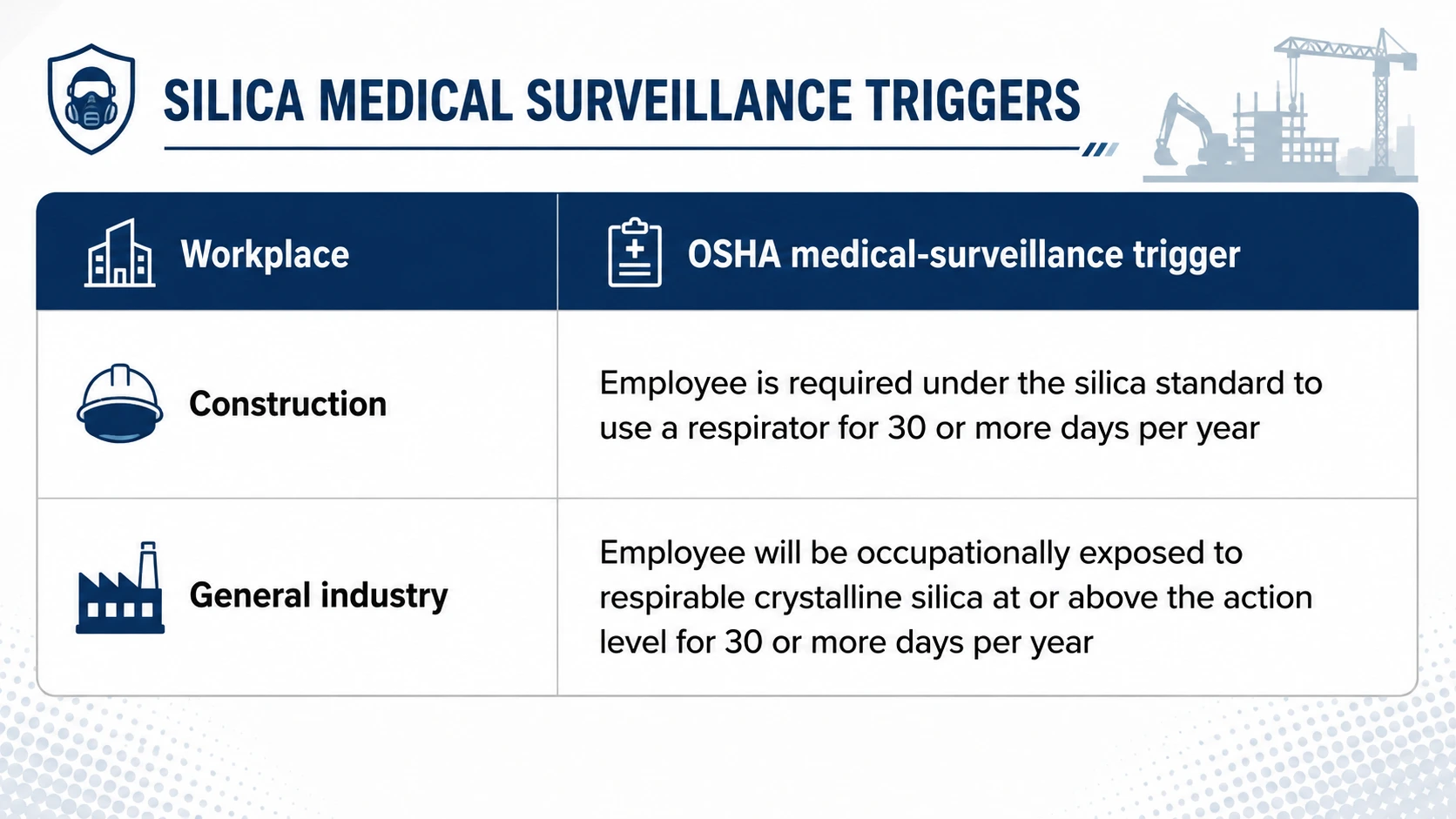
For general industry, OSHA defines the action level as 25 micrograms per cubic meter of air as an 8-hour time-weighted average. OSHA’s permissible exposure limit is 50 micrograms per cubic meter as an 8-hour TWA. Construction uses a different medical-surveillance trigger, based on required respirator use under the standard rather than simply applying the general-industry action-level test.
Employers should therefore avoid assuming that every worker who occasionally encounters silica automatically requires an OSHA silica medical exam. The employee’s tasks, exposure conditions, applicable OSHA standard, and number of qualifying days matter.
What Is Included in an OSHA Silica Medical Exam?
When surveillance is required, OSHA requires the employer to make it available at no cost to the employee and at a reasonable time and place. The initial examination generally must be made available within 30 days after initial assignment unless the employee has completed an examination meeting the standard’s requirements within the previous three years.
The baseline examination includes several specific components.
Medical and Work History
The PLHCP reviews past, present, and anticipated exposure to silica, dust, and other respiratory hazards, along with respiratory symptoms, tuberculosis history, and smoking history. A physical examination places particular emphasis on the respiratory system.
Silica Chest X-Ray and B Reader Classification
OSHA requires a chest radiograph taken at full inspiration using the specified posteroanterior projection. The silica chest X-ray must then be interpreted and classified according to the International Labor Organization classification system by a NIOSH-certified B Reader.
A B Reader chest X-ray is therefore more than simply obtaining a routine image. NIOSH’s B Reader program certifies physicians who demonstrate proficiency in classifying chest radiographs using the ILO system. Employers arranging surveillance should confirm how the required B Reader classification will be provided or coordinated.
Silica Pulmonary Function Test
The required silica pulmonary function test includes forced vital capacity, or FVC, forced expiratory volume in one second, or FEV1, and the FEV1/FVC ratio. OSHA requires the spirometry to be administered by a technician with a current certificate from a NIOSH-approved spirometry course.
Employers coordinating respiratory programs can also review Gulf Coast Occupational Medicine’s pulmonary function testing resources. GCOM currently lists pulmonary function and mobile respiratory testing among its occupational health services.
Latent Tuberculosis Testing
Testing for latent tuberculosis infection is part of the initial surveillance examination. It is not automatically repeated as part of every periodic examination under the silica standard. OSHA’s periodic-exam provision specifically excludes the baseline latent-TB requirement, although the PLHCP may determine that other testing is medically appropriate.
If your organization is coordinating multiple surveillance examinations or preparing a large project workforce, Gulf Coast Occupational Medicine can help employers organize occupational health services around clinic-based or on-site workforce needs. Employers remain responsible for determining which OSHA requirements apply to each employee.
How Often Are Silica Medical Exams Required?
OSHA does not establish a universal annual silica examination schedule.
After the baseline examination, required periodic medical examinations generally include the same components except the baseline latent-TB test and must be made available at least every three years. A PLHCP may recommend more frequent examinations when medically appropriate.
This distinction is important when building a respirable crystalline silica surveillance calendar. Employers should base scheduling on the applicable standard and PLHCP recommendations instead of automatically assigning every silica-covered employee to annual chest imaging or spirometry.
What Information Must the Employer Give the Medical Provider?
The surveillance process also depends on accurate information from the employer.
OSHA requires the employer to provide the examining PLHCP with a copy of the applicable standard and information concerning the employee’s former, current, and anticipated silica-related duties, known or anticipated exposure levels, personal protective equipment and expected duration of use, and relevant previous employment-related medical examinations under the employer’s control.
This is where organized job classifications and exposure records become important. Sending an employee for a generic physical without communicating the occupational exposure may not provide the information necessary for the PLHCP to complete the required surveillance process.
Gulf Coast Occupational Medicine also provides medical testing and monitoring services designed around employer screening and documentation needs.
What Does the Employer Receive After the Exam?
OSHA deliberately limits the medical information normally provided to the employer.
The employee receives a written medical report explaining the examination results, relevant medical findings, recommended respirator limitations, recommended silica-exposure limitations, and applicable specialist recommendations. The employer’s routine written medical opinion is more limited. It includes the examination date, confirmation that the examination met the standard, and recommended limitations on respirator use.
Recommended limitations on silica exposure and a recommendation for specialist examination may be provided to the employer when the employee gives written authorization. The employer should not assume that silica surveillance gives unrestricted access to the worker’s complete medical record, chest X-ray findings, or spirometry data.
If the chest radiograph is classified by the B Reader as 1/0 or higher, or the PLHCP otherwise determines specialist evaluation is appropriate, the standard provides for examination by a board-certified specialist in pulmonary disease or occupational medicine when the applicable requirements are met.
Preparing a Baton Rouge Construction Crew
A Baton Rouge industrial construction contractor is preparing 75 workers for a project involving concrete drilling, cutting, and other silica-generating tasks.
Rather than scheduling the same examination for every employee, the safety team first identifies the tasks each worker will perform and determines which employees are expected to be required under the construction silica standard to use respirators for 30 or more days during the year. Those employees are then organized for required medical surveillance.
The employer provides the occupational health provider with relevant job duties, anticipated exposure information, PPE details, and available prior examination records. Required examinations can then be coordinated with the appropriate silica chest X-ray, B Reader classification, silica pulmonary function test, medical history, physical examination, and baseline TB testing.
For larger projects, mobile occupational health services may help reduce employee travel by bringing appropriate screening services closer to the workforce. GCOM currently lists medical surveillance, pulmonary function testing, and other occupational health services among its mobile capabilities.
Build a More Consistent Silica Surveillance Process
Effective silica medical surveillance requirements management begins with determining which standard applies, identifying covered employees, completing the correct baseline components, scheduling periodic examinations appropriately, and maintaining the documentation the employer is entitled to receive.
Gulf Coast Occupational Medicine currently provides silica-related occupational health services, pulmonary function testing, X-ray capabilities, and mobile/on-site workforce support for industrial employers. Its website lists multiple Louisiana occupational medicine locations as well as mobile services for projects beyond its physical clinics. Call (225) 753-7233 to discuss silica medical screening and occupational health coordination for your workforce.
Employers should confirm that every component required for their specific surveillance program, including NIOSH-certified B Reader classification where applicable, is included or appropriately coordinated before scheduling a workforce screening.
Frequently Asked Questions
When are silica medical surveillance requirements triggered?
For construction, OSHA requires surveillance for employees who must use a respirator under the silica standard for 30 or more days per year. In general industry, the trigger is occupational exposure at or above the 25 µg/m³ action level for 30 or more days per year.
What tests are included in an OSHA silica medical exam?
The baseline examination includes medical and work history, a respiratory-focused physical examination, a qualifying chest X-ray with B Reader classification, pulmonary function testing, testing for latent tuberculosis infection, and other tests the PLHCP considers appropriate.
Does OSHA require a silica chest X-ray every year?
No. Required periodic examinations are generally provided at least every three years, unless the PLHCP recommends more frequent evaluation. The periodic examination includes the required chest radiograph but generally excludes repeat latent-TB testing as a standard component.
What is a B Reader chest X-ray?
A NIOSH-certified B Reader is a physician who has demonstrated proficiency in using the ILO system to classify chest radiographs for pneumoconiosis surveillance. OSHA requires this classification for the chest radiograph included in silica medical surveillance.
