
Facial Hair Does Not Automatically Disqualify Every Worker
For employers researching respirator fit test facial hair requirements, the key issue is not simply whether an employee has facial hair. OSHA’s respiratory protection standard prohibits an employer from allowing a worker to use a tight-fitting respirator when facial hair comes between the respirator’s sealing surface and the face or interferes with valve function. Facial hair that stays completely outside those areas may be acceptable.
That distinction matters for Louisiana construction, petrochemical, manufacturing, maintenance, and other industrial employers that depend on respiratory protection. Gulf Coast Occupational Medicine provides employer-focused occupational health services and currently supports respirator medical evaluations, qualitative and quantitative fit testing, and mobile/on-site testing coordination.
This article provides general occupational-health and regulatory information. Employers should evaluate their specific respiratory hazards, applicable OSHA standards, manufacturer requirements, and accommodation obligations before establishing a workplace policy.
What OSHA’s Respirator Fit Test Facial Hair Rule Actually Says
Under 29 CFR 1910.134, an employer cannot permit a tight-fitting facepiece to be worn when facial hair is located between the face and sealing surface or when it interferes with respirator valve function. OSHA also requires a user seal check each time a tight-fitting respirator is put on.
This means the OSHA beard respirator rules are based primarily on where the hair is located, not simply the existence of any facial hair.
OSHA has specifically explained that short mustaches, sideburns, and small goatees can potentially be acceptable when they are trimmed so that no hair compromises the respirator seal or valve function. By contrast, hair extending into the sealing area is not acceptable for tight-fitting respirator use.
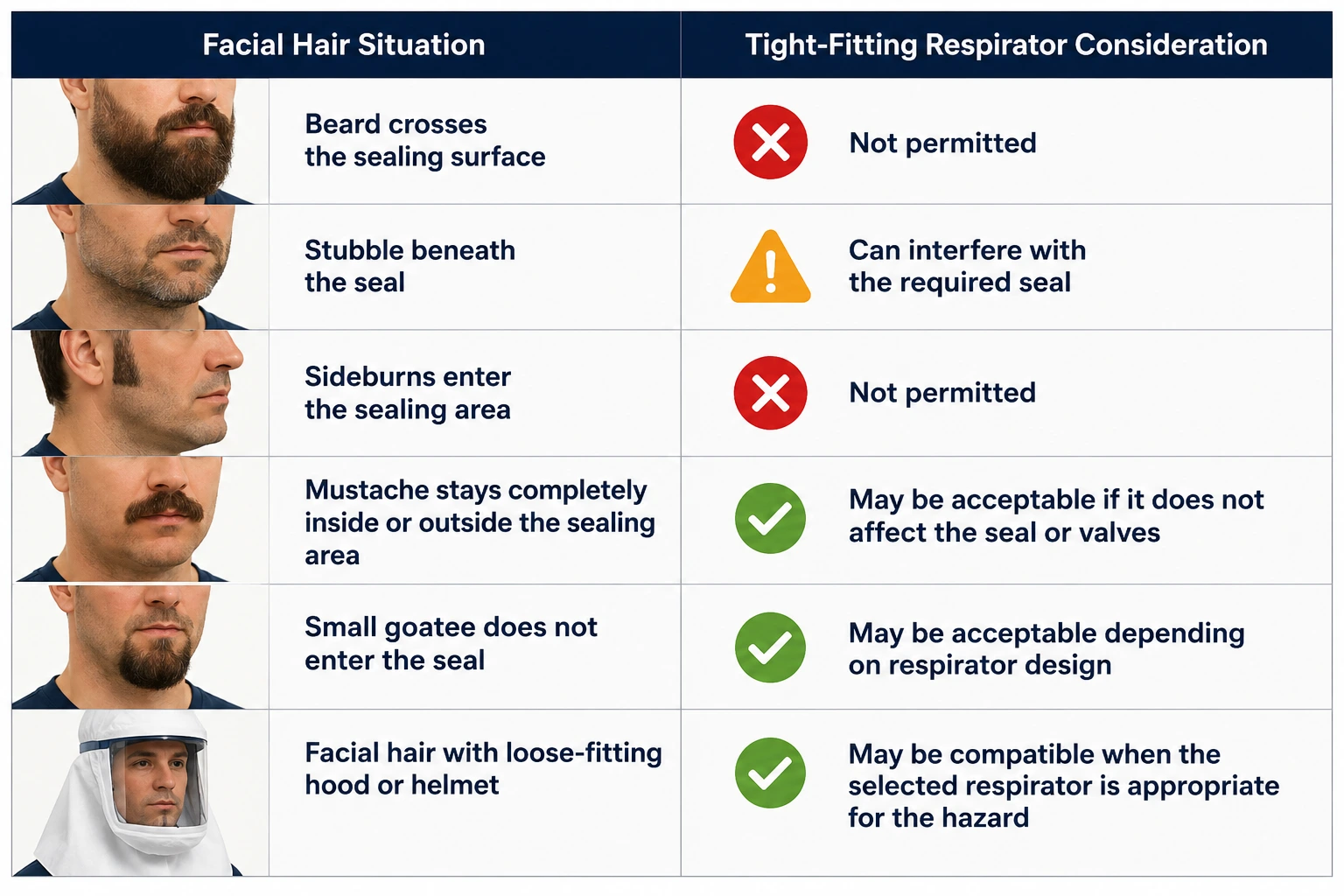
NIOSH also warns that even short stubble can reduce protection when it is located where a tight-fitting respirator must seal against the skin.
Passing a Fit Test Does Not Override an Improper Seal
One of the most important compliance points is that passing a test does not make facial hair beneath the sealing surface acceptable.
OSHA has directly addressed this situation. An employer whose records show that a worker passed a fit test while facial hair was present in the respirator sealing area is not considered compliant simply because the employee achieved a passing result. Hair growth, density, and positioning can change, making the resulting fit unreliable from one day to another.
For employers, the practical lesson is simple: a facial hair respirator seal must be evaluated before the testing process begins. Fit testing should not be treated as a way to see whether a beard that crosses the seal happens to pass that day.
Employees should understand this before arriving for testing so unnecessary scheduling problems can be avoided.
Medical Clearance Comes Before Fit Testing
Facial-hair requirements are only one part of a respiratory protection program. OSHA requires an employee to receive a medical evaluation to determine their ability to use a respirator before the employee is fit tested or required to use the respirator at work.
Medical evaluation and fit testing serve different purposes. Medical clearance addresses whether the worker can medically use the respirator under expected workplace conditions. Fit testing evaluates whether a specific tight-fitting make, model, style, and size properly fits that employee.
Employers can review Gulf Coast Occupational Medicine’s guidance on OSHA respirator medical evaluations and the distinction between respirator medical clearance and fit testing when organizing their process. GCOM currently offers medical-evaluation and fit-testing coordination for employer workforces.
If your organization is preparing workers for a turnaround, shutdown, construction project, or other respirator-required assignment, Gulf Coast Occupational Medicine can help coordinate medical evaluations and fit testing before employees reach the job site.
Annual Respirator Fit Testing Is Not the Only Testing Trigger
OSHA requires annual respirator fit testing for employees using tight-fitting facepiece respirators, but the annual test is only one requirement.
A worker must be fit tested before initial use, whenever a different respirator facepiece size, style, model, or make is used, and at least annually afterward. An additional fit test is also required when physical changes occur that could affect respirator fit, such as facial scarring, dental changes, cosmetic surgery, or an obvious change in body weight.
The employee must be tested using the same make, model, style, and size that will actually be used. Employers should therefore coordinate respirator purchasing, medical clearance, fit testing, and employee assignments rather than managing each step independently.
Can a PAPR Be Used for Bearded Workers?
A PAPR for bearded workers may be an option when the equipment uses a loose-fitting hood, helmet, or other configuration that does not depend on a tight facial seal. OSHA states that respirators that do not rely on a tight face seal can be used by bearded individuals, and OSHA has specifically recognized loose-fitting PAPRs as a potential alternative in appropriate circumstances.
However, a PAPR for bearded workers is not automatically suitable for every hazard. Respirator selection must be based on the contaminant, exposure conditions, required protection level, assigned protection factor, manufacturer limitations, and any applicable substance-specific standard. OSHA’s respiratory protection standard requires employers to select respirators that provide the necessary level of protection for the actual workplace hazard.
A loose-fitting PAPR also does not mean the rest of the respiratory protection program disappears. Medical evaluation, training, equipment maintenance, appropriate selection, and other applicable program requirements still matter.
Handle Religious and Medical Accommodation Requests Carefully
A grooming policy should address respiratory protection requirements without assuming that every facial-hair situation is identical.
Religious beliefs may require an employee to maintain a beard or other facial hair. Current EEOC religious accommodation guidance states that covered employers must consider reasonable accommodations for sincerely held religious practices unless providing the accommodation would create an undue hardship. The EEOC specifically identifies facial hair as a type of grooming practice that may require accommodation.
Medical conditions may also lead an employee to request a workplace adjustment. EEOC guidance advises employers not to automatically reject disability-related accommodation requests and to review requests individually when applicable.
Employers should coordinate HR, safety, occupational health, and legal resources as appropriate rather than treating a safety-based shaving rule as a substitute for evaluating an accommodation request.
Create a Clear Respirator Grooming Policy
A practical policy should explain that employees assigned tight-fitting respirators must keep the respirator’s sealing surface and valve areas free of interfering facial hair. It should also tell workers when to report for medical clearance and fit testing, identify who handles questions about respirator selection, explain annual respirator fit testing requirements, and provide a process for raising religious or medical accommodation requests.
The policy should focus on maintaining the required facial hair respirator seal, rather than using vague instructions that employees must always be completely clean-shaven regardless of respirator design or job assignment. OSHA’s interpretation specifically allows facial hair that does not protrude under the seal or interfere with valve function.
Preparing an Industrial Crew
A Baton Rouge industrial contractor is preparing 60 employees for a project requiring respiratory protection. Several workers arrive for clearance with facial hair.
Instead of immediately attempting every fit test, the employer verifies which respirator each employee will use and whether facial hair enters the sealing area. Workers assigned a tight-fitting respirator beard configuration that compromises the seal cannot rely on a passing fit-test result to overcome the seal requirement. Workers whose facial hair remains outside the seal can be evaluated under the applicable fit-testing procedure. Any accommodation requests are routed through the employer’s appropriate HR and safety process.
If an alternative respirator is being considered, the employer first verifies that it provides appropriate protection for the actual hazard rather than assuming every loose-fitting PAPR is interchangeable with the originally selected respirator.
For large crews, Gulf Coast Occupational Medicine currently provides mobile occupational health services that can include respirator medical evaluations and fit testing, helping employers bring appropriate testing closer to the job site.
Coordinate Respirator Readiness Before the Next Project
A sound respirator fit test facial hair process starts before the worker enters the testing room. Employers should identify the required respirator, complete medical evaluation first, address facial hair that may interfere with the seal, conduct required fit testing, and maintain a process for annual testing and appropriate accommodation requests.
Gulf Coast Occupational Medicine provides respirator medical evaluations, qualitative and quantitative fit testing, and mobile/on-site occupational health support for Louisiana employers. Employers can also review current Gulf Coast Occupational Medicine locations when planning workforce testing. Call (225) 753-7233 to discuss respirator clearance and fit-testing coordination for your workforce.
Frequently Asked Questions
Can a worker with a beard pass a respirator fit test?
It depends on where the facial hair is located. OSHA allows facial hair that does not enter the sealing surface or interfere with respirator valve function. Hair beneath the sealing surface of a tight-fitting respirator is not permitted, even if the employee obtains a passing fit-test result.
Does OSHA require workers to be completely clean-shaven?
Not universally. The OSHA beard respirator rules prohibit facial hair that interferes with the sealing surface or valve function of a tight-fitting respirator. A short mustache, sideburns, or small goatee may be acceptable when it remains outside the affected areas.
How often does a worker need respirator fit testing?
Employees using tight-fitting respirators must be fit tested before initial use, when they change to a different facepiece, and at least annually thereafter. Additional testing can be required when physical changes could affect respirator fit.
Can a loose-fitting PAPR solve a facial-hair issue?
It may be an appropriate option because some loose-fitting PAPRs do not depend on a tight facial seal. The employer must still determine whether the selected respirator provides adequate protection for the specific workplace hazard and meets all applicable respiratory protection requirements.
