
Choose a Provider for Your Workforce, Not Just the Nearest Clinic
Selecting an occupational health vendor affects far more than where employees go for a physical or drug test. The provider may become part of injury response, workforce mobilization, medical surveillance, DOT testing, work-status communication, remote-project support, and employer reporting. A useful occupational health provider RFP should therefore evaluate whether a vendor can support the workforce and regulatory programs the employer actually operates.
For employers in Louisiana and organizations managing employees across multiple locations, the evaluation should account for both local access and broader operational coverage. Gulf Coast Occupational Medicine currently provides clinic-based occupational health services along with mobile and on-site capabilities, network-supported scheduling, and employer-facing digital tools. This article explains how EHS, HR, operations, and procurement teams can build a consistent vendor evaluation without treating clinic proximity as the only deciding factor.
Define the Workforce Requirements Before Sending the RFP
A strong occupational health provider RFP begins with the employer’s requirements, not a generic list of medical services.
Before contacting vendors, document:
- Employee and contractor populations by location
- Safety-sensitive positions and regulated programs
- Expected hiring and project-mobilization volumes
- Routine versus episodic testing needs
- Workplace injury response requirements
- Clinic, mobile, and remote-site needs
- After-hours escalation expectations
- DOT and non-DOT drug and alcohol programs
- Respiratory and other medical-surveillance programs
- Required diagnostics and examinations
- Employer reporting and dashboard needs
- Training needs when applicable
- Expected implementation and account-management support
The goal is to create an occupational health vendor evaluation based on actual use cases. A vendor located five minutes from headquarters may be a poor operational fit if most employees work at remote projects or require services the clinic cannot provide.
Evaluate Clinical Scope and Regulatory Program Support
An occupational medicine provider checklist should ask vendors to identify exactly which services they perform themselves, which are handled through partners, and which require referral.
For example, Gulf Coast’s current occupational health services page lists workplace injury care, physical examinations, pulmonary function testing, respirator fit testing, vision and hearing testing, drug and alcohol testing, X-ray, EKG, laboratory services, mobile care, and on-site services.
For regulated services, do not accept a broad statement such as “we handle compliance.” Ask the vendor to explain how each applicable program is administered.
DOT-regulated employers are a good example. Current 49 CFR Part 40 allows employers to use qualified service agents, but the employer remains responsible for meeting applicable DOT requirements and for ensuring service agents are qualified. DOT and non-DOT testing also must remain separate.
Respiratory programs provide another example. OSHA’s Respiratory Protection Standard requires medical evaluation before required respirator use and specifies confidentiality and the limited information included in the PLHCP’s written recommendation. An RFP should determine whether the provider understands both the clinical service and the required information flow.
Test Geographic Coverage, Mobile Capability, and After-Hours Response
An employer with multiple facilities should ask more than, “Where are your clinics?”
Request a coverage map showing owned clinics, affiliated clinics, mobile service areas, remote scheduling processes, and escalation contacts.
Gulf Coast currently lists Louisiana locations in Baton Rouge, Gonzales, Geismar, Addis, Walker, Reserve, and an appointment-only contractor location in Plaquemine. Its current location page also lists additional NuREADY and Business Health Partners markets and describes mobile occupational health deployment throughout the United States. Review current Gulf Coast Occupational Medicine locations.
Employers comparing delivery models can also review GCOM’s mobile versus clinic occupational health comparison when deciding whether the RFP should require one model or a combination.
For after-hours support, require vendors to distinguish among physical clinic hours, call-out services, telehealth, mobile response, and emergency escalation. Do not treat “24/7 support” as automatically meaning every physical clinic operates around the clock.
Evaluate Reporting, Technology, Communication, and Privacy
Employer reporting often separates an adequate provider from an operationally useful one.
Ask vendors to demonstrate:
- Employer dashboards and permission controls
- Work-status reporting
- Testing-status visibility where appropriate
- Medical-surveillance documentation workflows
- Multi-site employee tracking
- Report delivery methods
- Service-specific turnaround expectations
- Escalation procedures for delayed or incomplete cases
- Data exports and reporting formats
- Record retention and access procedures
- Account-management structure
- Incident and confidentiality escalation processes
Gulf Coast’s current website describes an integrated electronic platform with employer access to testing histories, compliance status, training information, and customizable dashboard permissions, along with coordination across clinic and mobile services.
Privacy questions should be specific rather than relying on the phrase “HIPAA compliant.” Different occupational records can be governed by different rules. EEOC guidance, for example, addresses confidentiality of employment-related medical information and circumstances in which medical examinations may be permitted. Review EEOC medical examination guidance.
Planning an Occupational Health Vendor Evaluation?
If your organization is preparing an occupational health services RFP, Gulf Coast Occupational Medicine can discuss clinic-based, mobile, on-site, testing, examination, surveillance, and workforce-management capabilities so your procurement team can determine whether those services match the scope you are building.
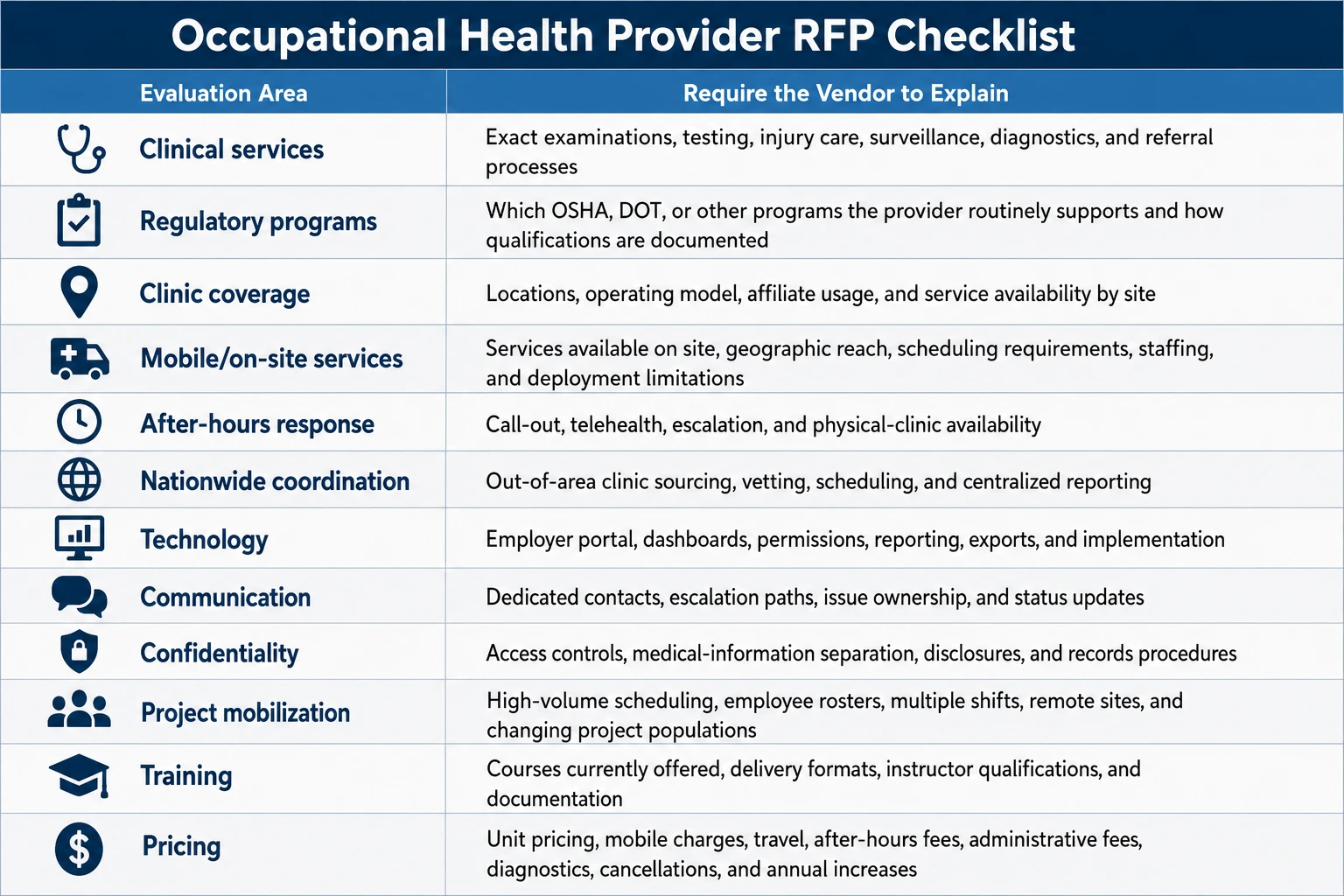
Occupational Health Provider RFP Checklist
Use a Weighted RFP Scoring Matrix
A simple scoring model helps HR, EHS, operations, and procurement teams compare providers using the same criteria.
The following is an illustrative starting point. Employers should adjust the weighting to match their workforce.
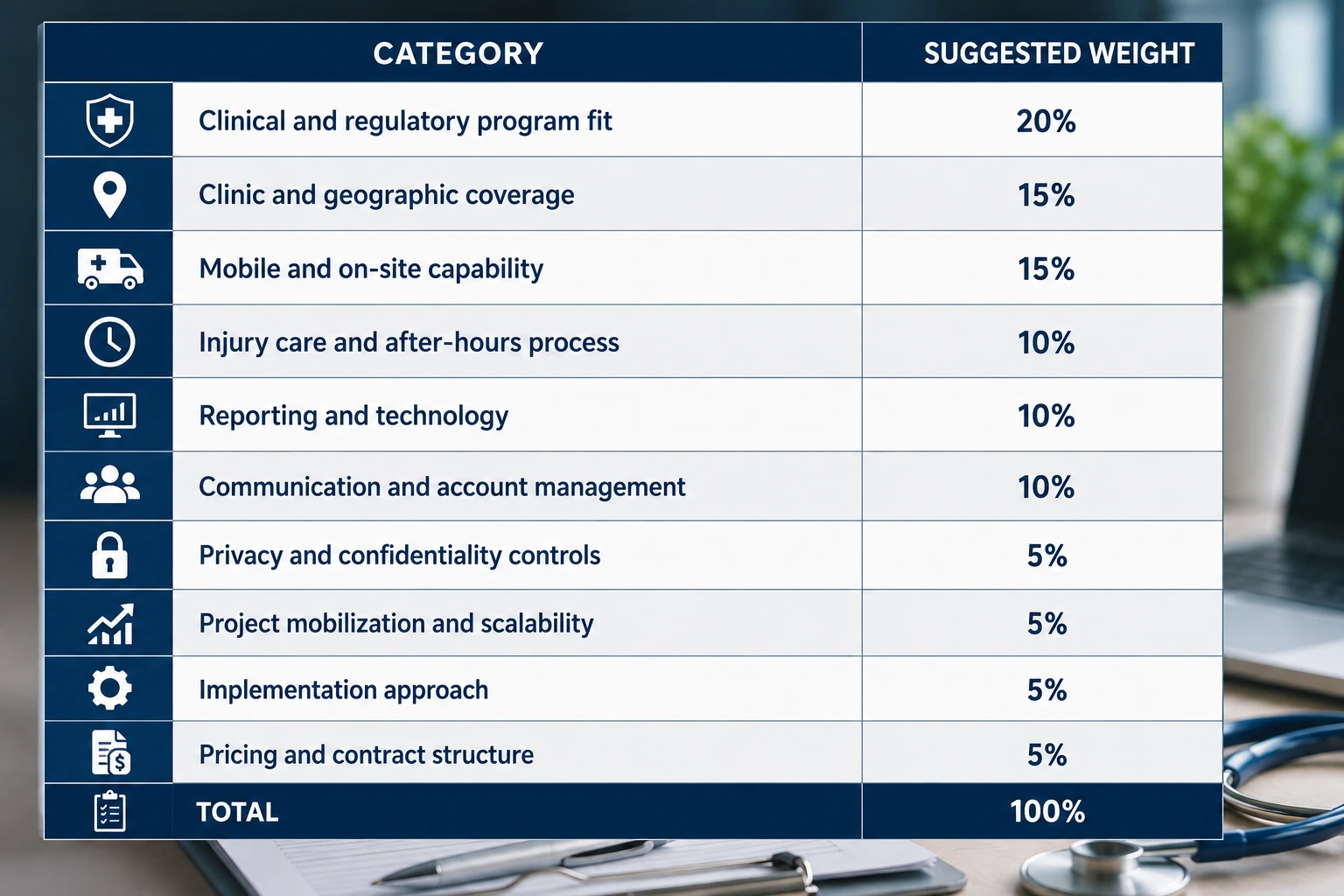
Score each category from 1 to 5, then multiply the score by the assigned weight. A scoring matrix prevents one attractive price or nearby clinic from overshadowing critical service gaps.
Compare Pricing as a Complete Service Model
Price comparisons should use the same assumptions for every vendor.
Request pricing for routine examinations, drug and alcohol testing, diagnostics, medical surveillance, mobile deployment, travel, after-hours service, specialty referrals, account administration, portal access, cancellations, and project-specific staffing where applicable.
Also ask what is excluded.
A lower per-test price may not represent the lowest operational cost if an employer must coordinate multiple vendors, manually reconcile reports, or send employees long distances for services outside the vendor’s scope. This does not mean the broadest provider is automatically the right choice. It means pricing should be evaluated alongside actual workforce requirements.
GCOM’s existing workforce health management resource provides additional context for employers considering how separate occupational health functions fit into a broader workforce program.
Comparing Providers for an Industrial Contractor
A Baton Rouge industrial contractor employs 75 year-round workers but regularly mobilizes additional crews to projects outside Louisiana.
Its requirements include workplace injury care, drug and alcohol testing, respiratory evaluations, physical examinations, mobile screening during major mobilizations, and centralized employer reporting.
Provider A has a clinic close to headquarters but limited mobile capability and requires the employer to arrange several out-of-area services separately.
Provider B is slightly farther from headquarters but can support the required clinical scope, mobile screenings, centralized coordination, and remote-project scheduling.
The correct choice is not automatically Provider B. The employer should score both providers against the same RFP matrix, validate capabilities, compare pricing, review implementation plans, and determine which model best fits its workforce.
That is the purpose of an employer medical provider selection process: choosing based on operational requirements rather than a single convenience factor.
Build Your RFP Around the Workforce You Actually Have
A useful occupational health provider RFP should test clinical capability, geographic access, mobile support, regulatory-program experience, communication, reporting, privacy, project scalability, and total pricing.
Gulf Coast Occupational Medicine currently provides employer-focused occupational health services through Louisiana clinics, mobile and on-site operations, network-supported scheduling, testing, regulatory examinations, medical surveillance, injury care, diagnostics, and employer reporting tools. Availability and project-specific requirements should always be confirmed before contracting.
Call Gulf Coast Occupational Medicine at (225) 753-7233 to discuss your workforce requirements, occupational health program, or upcoming vendor evaluation. The number is currently listed on Gulf Coast’s Locations and Contact pages.
Frequently Asked Questions
What should an occupational health RFP include?
It should define required services, locations, employee populations, regulatory programs, mobile needs, after-hours expectations, reporting, technology, confidentiality, account management, implementation, and pricing.
Should employers choose the closest occupational health provider?
Not necessarily. Clinic proximity matters, but employers should also evaluate service scope, remote coverage, mobile capabilities, reporting, regulatory-program support, and the locations where employees actually work.
How should employers evaluate occupational health reporting?
Ask vendors to demonstrate dashboards, access controls, work-status reporting, testing workflows, escalation procedures, data exports, and service-specific reporting expectations. Avoid relying only on generic claims about “fast results.”
Can an occupational health vendor take responsibility for an employer’s regulatory compliance?
A provider can support required medical and testing programs, but employers should not treat vendor selection as transferring all regulatory responsibility. For example, DOT Part 40 specifically states that employers remain responsible for applicable requirements even when qualified service agents are used.
