
When the Clinic Is Miles Away, the Imaging Decision Still Starts With Medical Need
Sending an employee away from a remote jobsite for an X-ray can add travel, scheduling, and administrative handoffs. But bringing an X-ray unit to the worksite does not mean every employee or every injury should be imaged.
A well-planned mobile X-ray occupational health service starts with the reason imaging is needed. It may support certain workplace injury evaluations, occupational medical examinations, or medical-surveillance protocols while allowing appropriate employees to complete services closer to where they work. Gulf Coast Occupational Medicine currently lists digital X-ray among the capabilities available through its clinics and mobile medical units, alongside employer-focused occupational health services.
This guide explains where mobile X-ray can fit, when it should not be used, what employers need to organize before scheduling, and how to combine imaging with other occupational-health services without ordering unnecessary testing.
What Does Mobile X-Ray Occupational Health Mean?
Mobile digital radiography brings appropriate X-ray capability to an employer location rather than automatically sending each employee to an off-site imaging facility. GCOM currently identifies digital X-ray as part of its mobile health technology and lists X-ray among its on-site occupational services.
The important word is appropriate.
The FDA recommends that medical X-ray examinations be justified by a clinical need and optimized to obtain the necessary diagnostic information while minimizing radiation exposure. An employer’s desire for convenience is not, by itself, a reason to order imaging. FDA guidance on medical X-ray imaging
That makes mobile imaging a delivery option, not a universal screening requirement.
When Mobile Workplace X-Ray May Be Useful
Evaluating Certain Non-Emergency Workplace Injuries
For an employee with a work-related injury, radiography may be useful when a healthcare professional determines that imaging is clinically appropriate. Conventional radiography can help evaluate structural injuries and other conditions that may be visible on X-ray. FDA information on radiography
An onsite occupational X-ray can be especially practical at a remote industrial site or project location when an appropriate clinical evaluation and imaging capability are already available there.
But X-ray is not appropriate for every strain, sprain, bump, or workplace complaint. It also cannot replace emergency or advanced hospital evaluation when the employee’s condition requires a higher level of care.
Supporting Specific Medical-Surveillance Programs
Chest imaging can also be part of certain occupational medical-surveillance protocols.
For example, OSHA’s construction silica standard requires medical surveillance for employees who must use a respirator under the standard for 30 or more days per year. The required baseline examination includes a chest X-ray that must be classified according to the ILO system by a NIOSH-certified B Reader. Periodic examinations are generally required at least every three years, or more frequently if recommended by the physician or other licensed healthcare professional. OSHA respirable crystalline silica standard
OSHA’s general-industry asbestos standard also includes chest radiography within medical surveillance, but the frequency of the X-ray follows the standard’s specific schedule rather than a universal annual imaging rule. OSHA asbestos medical-surveillance requirements
The takeaway for employers is simple: do not build an X-ray schedule from a generic checklist. Build it from the actual exposure, job, applicable standard, and clinical protocol.
Clinical Interpretation and B Reader Classification Are Not the Same Thing
This is an important distinction for employers arranging jobsite X-ray services.
A routine diagnostic X-ray needs appropriate clinical interpretation. A B Reader classification serves a more specific occupational-surveillance purpose. NIOSH trains and certifies B Readers to classify chest radiographs for pneumoconiosis using the ILO classification system. NIOSH also notes that this classification is not typically performed for clinical diagnostic purposes. NIOSH B Reader Program
GCOM states that it can coordinate NIOSH-certified B Reader interpretation for silica and asbestos surveillance programs when ILO classification is required. Employers can review its physical exams, health surveillance, and diagnostic services when planning a program.
Before scheduling, ask two separate questions:
- Who will provide the clinical interpretation?
- Does the applicable surveillance program also require B Reader classification?
That prevents an employer from treating two different functions as if they were interchangeable.
Planning a Mobile Imaging Day?
If you are preparing for a turnaround, project mobilization, surveillance cycle, or remote-site screening event, organize the details before requesting deployment.
Give Gulf Coast Occupational Medicine your worksite location, estimated employee count, requested services, target dates, applicable medical-surveillance protocol, and any related occupational screenings. GCOM can then help determine whether its on-site occupational health services or clinic-based services better match the situation.
That is a stronger booking process than simply asking, “Can you bring an X-ray truck?”
Mobile X-Ray Does Not Replace Emergency or Specialty Care
Convenience should never determine the level of medical care.
A mobile unit may be appropriate for planned surveillance or certain non-emergency occupational evaluations, but an employee with severe trauma, significant uncontrolled bleeding, loss of consciousness, severe breathing difficulty, suspected major head or spinal injury, or another potentially life-threatening condition needs appropriate emergency evaluation.
Likewise, an X-ray may not provide the information needed for every injury. Some employees may require CT, MRI, specialist evaluation, hospital services, or other diagnostic testing based on the clinical situation.
For employers deciding between delivery models, GCOM’s mobile versus clinic occupational health guide provides additional context on when centralized clinic care or on-site services may be more practical.
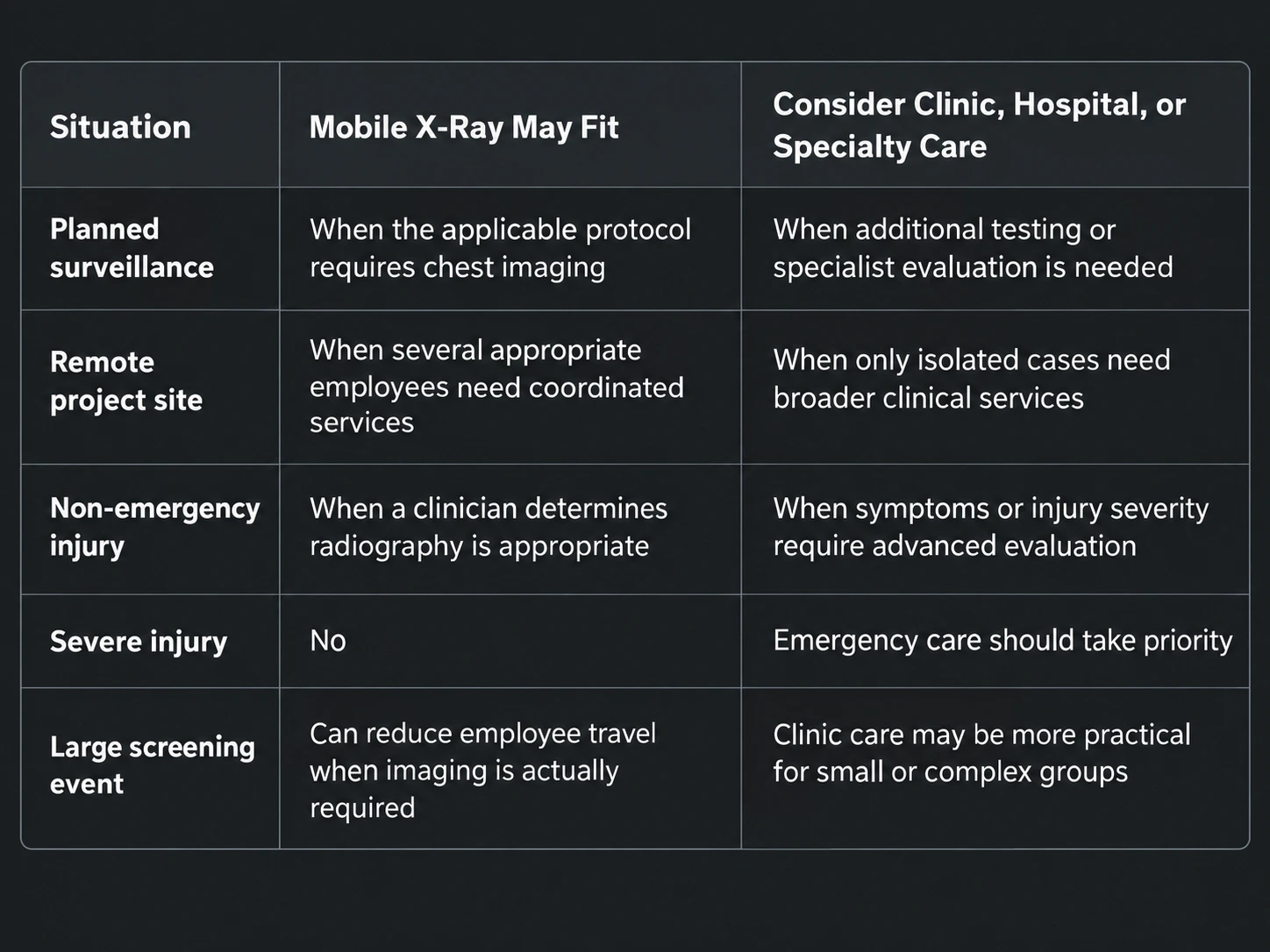
Employer Checklist Before Booking On-Site Occupational X-Ray
A smoother mobile X-ray occupational health deployment starts with information the provider can actually use.
Before booking, confirm:
- Reason for imaging: workplace injury evaluation, surveillance, occupational examination, or another clinically appropriate purpose.
- Workforce size: how many employees actually require X-ray rather than the total project headcount.
- Employee roster: identify which workers are scheduled and which protocol applies to each group.
- Medical order or surveillance protocol: confirm what imaging is required and who determines medical necessity.
- Worksite access: provide site location, parking or staging information, access restrictions, and the on-site contact.
- Schedule: identify shifts, project dates, and realistic employee-release windows.
- Related screenings: determine whether physical examinations, spirometry, or other verified occupational services should be coordinated during the same event.
- Results workflow: establish who receives appropriate employer-facing documentation and how employees receive clinically relevant findings.
- Follow-up plan: know where employees will be directed when imaging identifies a need for additional clinical or specialty evaluation.
- Emergency pathway: maintain a separate process for employees whose conditions require emergency care.
This information also helps the occupational-health provider determine whether mobile deployment or a clinic appointment is the more practical option.
A Remote Industrial Project
A Louisiana industrial contractor is preparing a remote project workforce. Some employees fall under a silica medical-surveillance protocol that includes chest radiography, while other workers require physical examinations but no X-ray.
Rather than scheduling the entire workforce for identical testing, the employer divides employees according to the actual protocol. The roster identifies which workers need chest imaging, which employees require other occupational screenings, the worksite schedule, and the responsible project contact.
The employer then discusses mobile service logistics with the occupational health provider. Appropriate services can be coordinated at the site, while any employee requiring more advanced evaluation is routed to the appropriate clinic, specialist, or hospital.
This approach reduces unnecessary employee travel without turning convenience into unnecessary medical testing.
Bring the Right Occupational Health Services to Your Worksite
The best mobile X-ray occupational health strategy is not “X-ray everyone on-site.” It is to identify who actually needs imaging, why it is needed, which protocol applies, how results will be interpreted, and what happens when additional evaluation is necessary.
Gulf Coast Occupational Medicine currently provides digital X-ray through its occupational health clinics and mobile medical units, with mobile and on-site services available for employer workforces and project locations.
Planning a mobile screening event or jobsite X-ray service? Have your location, workforce count, requested services, target dates, and applicable medical protocol ready. Then call Gulf Coast Occupational Medicine at (225) 753-7233 or use the GCOM contact page to discuss whether mobile or clinic-based imaging is the better fit for your workforce.
Frequently Asked Questions
Can an employer arrange mobile X-ray services at a worksite?
Yes. Gulf Coast Occupational Medicine currently lists digital X-ray among the services available through its mobile medical units. Availability and the appropriate service setup should be confirmed for the specific worksite, workforce, and clinical need.
Does every workplace injury need an X-ray?
No. X-ray should be used when clinically appropriate. The FDA recommends that imaging involving ionizing radiation be justified by a medical need rather than performed routinely without a clinical reason.
Do all medical-surveillance programs require chest X-rays?
No. Requirements depend on the hazard and applicable standard. OSHA’s silica and asbestos standards are examples of programs that may require chest radiography for covered workers, but their eligibility criteria and schedules differ.
What should I have ready before requesting mobile X-ray occupational health services?
Prepare the worksite location, estimated number of employees needing imaging, reason or applicable surveillance protocol, target dates, shift schedule, related occupational-health services, site contact, and expected reporting or follow-up needs. Providing these details helps the occupational health provider recommend the appropriate deployment model.
