
Stop Managing Medical Surveillance From Memory
Medical surveillance becomes difficult to manage when exposure assessments, employee rosters, examination dates, and regulatory requirements live in separate spreadsheets or depend on someone remembering what comes next. A medical surveillance matrix creates a central administrative framework that connects job roles and workplace hazards with the applicable standard, surveillance trigger, examination requirements, responsible manager, and next action date.
Employers should build the matrix around actual workforce exposures rather than assigning every employee the same annual physical. Gulf Coast Occupational Medicine supports employer occupational health programs with examinations, pulmonary function testing, respirator fit testing, hearing testing, diagnostics, medical surveillance services, and clinic-based or mobile/on-site options where appropriate. GCOM’s current service page confirms these capabilities.
The matrix itself is an employer management tool. OSHA does not prescribe one universal medical surveillance spreadsheet. OSHA’s Medical Screening and Surveillance Requirements Guide is a useful starting reference, but OSHA expressly states that the guide is not a regulation and that employers must consult the specific applicable standard for complete requirements.
Start With the Hazard, Not the Medical Test
An effective occupational health compliance matrix should begin with the employer’s hazard assessment and exposure information.
The basic question is not:
“What physical should this employee receive?”
It is:
“What hazard or regulated assignment applies to this employee, which standard governs it, and what does that standard require?”
That distinction matters because OSHA medical surveillance requirements differ considerably by hazard. A silica-covered construction worker, HAZMAT-team member, employee in a hearing conservation program, and worker required to use a respirator may all have different triggers, intervals, examinations, and documentation requirements.
A useful matrix should track job role, exposure or hazard, governing standard, triggering condition, baseline requirement, periodic interval, triggered examinations, required testing, clinician documentation, next due date, and the manager responsible for follow-up.
Example Medical Surveillance Matrix by Hazard
The following example is an administrative starting point. Employers should verify each requirement against the complete applicable standard and the employee’s actual exposure circumstances.
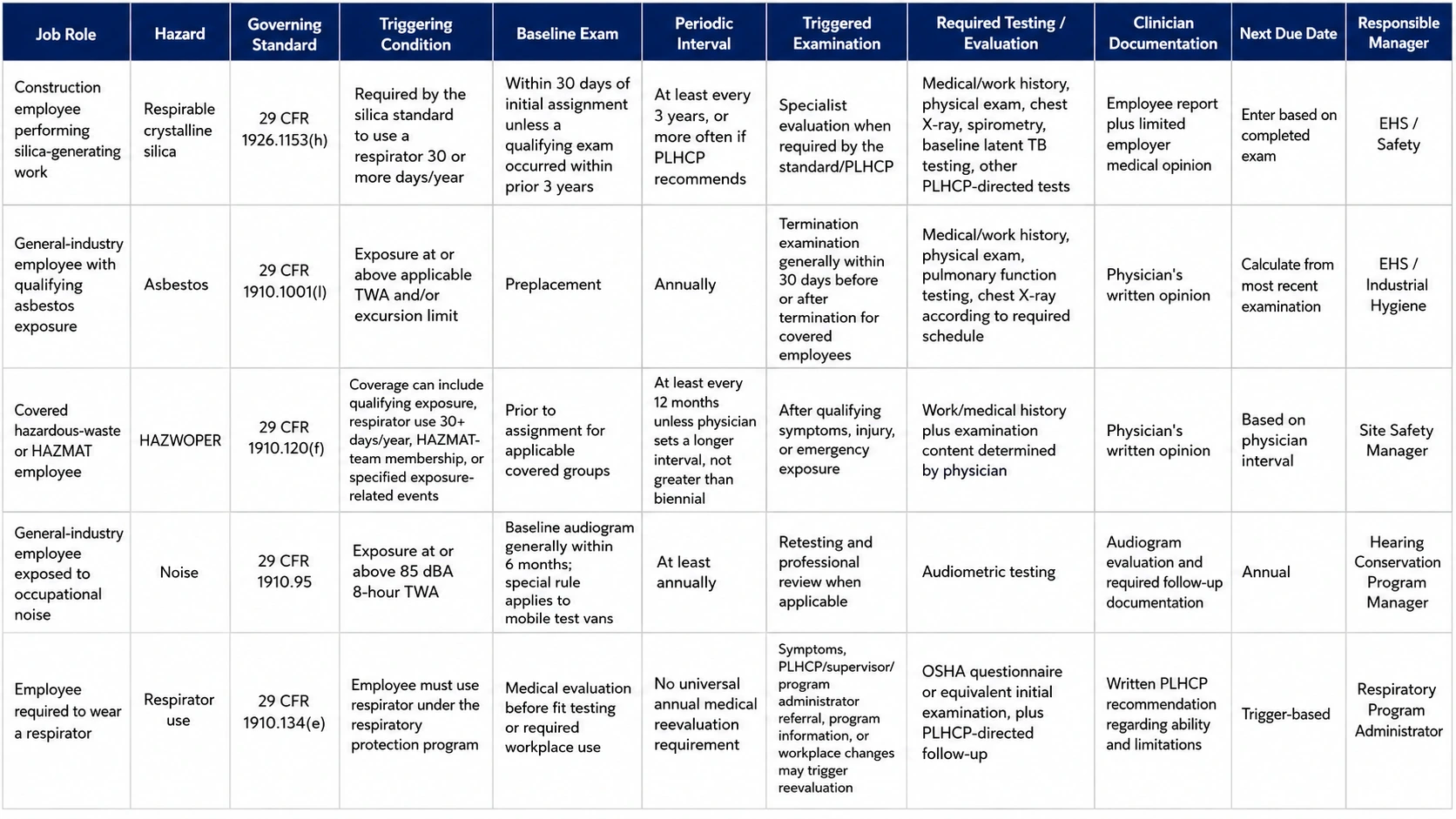
Silica Shows Why Triggering Conditions Matter
Under OSHA’s construction silica standard, medical surveillance must be made available to employees who are required under the standard to use a respirator for 30 or more days per year. Periodic examinations are required at least every three years, or more frequently when recommended by the PLHCP. Employers should review the complete OSHA Respirable Crystalline Silica Standard, 29 CFR 1926.1153 when building the silica row of the matrix.
This is why a medical surveillance by hazard approach works better than automatically scheduling the same exam for everyone with “silica exposure” somewhere in a job description. The employer must determine which regulatory trigger actually applies.
Asbestos Requires Its Own Schedule
General-industry asbestos requirements are different. OSHA’s general-industry standard requires annual periodic medical examinations for covered employees and provides for a termination examination within 30 calendar days before or after termination for employees covered by that provision.
The full requirements, including examination elements and chest X-ray frequency rules, are available in OSHA’s Asbestos Standard, 29 CFR 1910.1001.
The matrix should therefore identify the specific asbestos standard rather than simply using a generic “asbestos physical” category.
Track Event-Driven Requirements Alongside Calendar Dates
A strong medical surveillance schedule needs more than a next-due-date column.
HAZWOPER is a useful example. The standard covers several groups, including employees with qualifying hazardous-substance exposures, certain employees who wear respirators for 30 or more days per year, employees with specified exposure-related injuries or symptoms, and members of HAZMAT teams.
For applicable groups, examinations can be required before assignment and generally at least every 12 months, although the attending physician may select a longer interval that cannot exceed biennial. Specified exposures, injuries, or symptoms can also trigger additional evaluation. Employers should use OSHA’s HAZWOPER Standard, 29 CFR 1910.120 when defining those triggers.
A matrix that tracks only “annual physical due 10/1” could miss an examination triggered by an emergency exposure months before that date.
Coordinate the Surveillance Program Around the Workforce
If your organization manages several exposure groups, projects, or locations, Gulf Coast Occupational Medicine’s occupational health services can support appropriate medical surveillance examinations, respiratory testing, hearing testing, diagnostics, and other workforce health services. Clinic-based and mobile/on-site capabilities can also help employers organize higher-volume programs around workforce needs.
Connect Noise Exposure Data to Audiometric Testing
Under OSHA’s general-industry noise standard, employers must establish an audiometric testing program for employees whose exposures equal or exceed an 8-hour time-weighted average of 85 decibels.
A valid baseline audiogram is generally required within six months of the employee’s first exposure at or above the action level. A mobile test van exception allows additional time under specified conditions. After the baseline, a new audiogram is required at least annually for covered employees.
Those details belong directly in an employee medical surveillance checklist. See OSHA’s Occupational Noise Exposure Standard, 29 CFR 1910.95 for the complete requirements.
Do Not Confuse Respirator Medical Evaluation With Annual Fit Testing
Respiratory protection is another area where disconnected spreadsheets can create unnecessary confusion.
OSHA requires a medical evaluation before an employee is fit tested or required to use a respirator. Additional medical evaluations are triggered by circumstances such as relevant symptoms, a recommendation from the PLHCP, supervisor, or program administrator, information obtained during the respiratory program, or workplace changes that substantially increase physiological burden.
That medical reevaluation requirement is different from tight-fitting respirator fit testing, which is required before initial use and at least annually thereafter. Employers should review OSHA’s Respiratory Protection Standard, 29 CFR 1910.134 and GCOM’s respirator medical evaluation guidance when building separate medical-evaluation and fit-testing fields.
Connect the Matrix to Employee Rosters and Scheduling
A medical surveillance matrix becomes operationally useful when it links:
Hazard assessment → job assignment → employee roster → required surveillance → scheduling → documentation → next due date
For example, if industrial hygiene data moves an employee into a covered noise-exposure group, the roster should trigger review of the hearing conservation requirements. If an employee begins a role requiring respirator use, the respiratory program administrator should be able to identify whether the required medical evaluation has been completed before fit testing.
Assigning a responsible manager to every row also prevents EHS, HR, supervisors, and occupational health administrators from assuming someone else is handling the next step.
Keep Administrative Status Separate From Clinical Records
The matrix should help managers answer administrative questions such as:
- Is the employee included in the applicable surveillance program?
- Was the required evaluation completed?
- Has the employer received the documentation the standard permits or requires?
- When is another scheduled or triggered action due?
It should not become a general repository for unrestricted clinical information.
Some OSHA standards specifically limit the medical information provided to employers. Respiratory protection, for example, requires the PLHCP’s written recommendation to address information such as ability to use the respirator, limitations, and follow-up needs rather than providing an unrestricted clinical record.
GCOM’s current website also describes electronic reporting and employer dashboards. Employers should still configure access according to the information legitimately needed for the occupational health program rather than treating administrative tracking as unrestricted access to medical records.
One Workforce, Several Requirements
A Baton Rouge industrial contractor is organizing medical surveillance for 75 employees.
Some workers perform silica-generating construction work. Others belong to a HAZMAT team. Another group works in areas covered by a hearing conservation program, while certain employees must wear respirators.
Instead of placing all 75 employees on one annual physical schedule, the EHS team maps each employee to the applicable hazard and governing standard. The matrix tracks the regulatory trigger, baseline requirement, recurring interval, event-driven examination requirements, documentation status, next due date, and responsible manager.
When an employee changes assignments or new exposure information becomes available, the employer reviews the applicable matrix row rather than automatically continuing the old schedule.
Turn Your Matrix Into a Working Medical Surveillance Program
A medical surveillance matrix should function as the connection point between hazard assessments, workforce assignments, medical requirements, scheduling, documentation, and management accountability.
Start with the applicable hazard and regulatory standard. Define the exact trigger. Separate baseline, periodic, and event-driven requirements. Assign responsibility and review the matrix whenever job duties, exposures, processes, or applicable requirements change.
Gulf Coast Occupational Medicine currently offers occupational health services relevant to employer medical surveillance programs, including physical examinations, pulmonary function testing, respirator fit testing, hearing testing, X-ray and laboratory capabilities, along with clinic-based and mobile/on-site services.
Call Gulf Coast Occupational Medicine at (225) 753-7233 to discuss medical surveillance and occupational health services for your workforce. The current main number is confirmed on GCOM’s contact page.
Frequently Asked Questions
What is a medical surveillance matrix?
A medical surveillance matrix is an employer-created tracking framework that connects jobs and hazards to applicable regulatory standards, surveillance triggers, examinations, testing, intervals, documentation, responsible managers, and next due dates. It does not replace the requirements of the applicable OSHA standard.
Does every employee exposed to a workplace hazard require medical surveillance?
No. The trigger depends on the specific standard. It may depend on exposure level, duration, respirator use, job assignment, symptoms, or a qualifying exposure event. OSHA recommends consulting the individual standard for complete requirements.
How often should medical surveillance examinations occur?
There is no universal interval. Construction silica surveillance for covered employees is generally offered at least every three years, general-industry asbestos periodic examinations are annual for covered employees, hearing-conservation audiograms are annual after the baseline, and applicable HAZWOPER examinations generally occur at least every 12 months unless a permitted longer physician-selected interval applies.
Can Gulf Coast Occupational Medicine help coordinate medical surveillance services?
Gulf Coast Occupational Medicine currently lists physical examinations, pulmonary function testing, respirator fit testing, hearing testing, X-ray, laboratory services, and mobile/on-site capabilities among its occupational health offerings. Employers should identify the applicable standard and surveillance requirements first, then confirm the specific services needed for the workforce.
