
If You Find the Expired Clearance at the Gate, You Found It Too Late
A worker can be trained, scheduled, and ready for a project, but one expired or incomplete medical requirement can still disrupt mobilization. The better time to discover that gap is 90 days before the employee is expected on site, not the morning the crew is supposed to start.
That is the purpose of medical clearance tracking. Employers need a repeatable way to see who requires an examination or surveillance service, when the next action is due, what testing remains incomplete, which project the employee is assigned to, and who is responsible for closing the gap.
Gulf Coast Occupational Medicine currently provides employer-focused occupational health services through multiple Louisiana clinics, mobile units, and on-site programs. Its website also describes centralized digital reporting for compliance status, testing history, and workforce health administration.
The goal is not to create another spreadsheet nobody trusts. It is to create an operational system that tells HR, safety, and project leaders what needs attention before a clearance issue affects the workforce.
What Should an Employee Medical Clearance Tracker Include?
A useful employee medical clearance tracking system should answer a management question quickly:
Who needs what, by when, for which job or project?
At minimum, track:
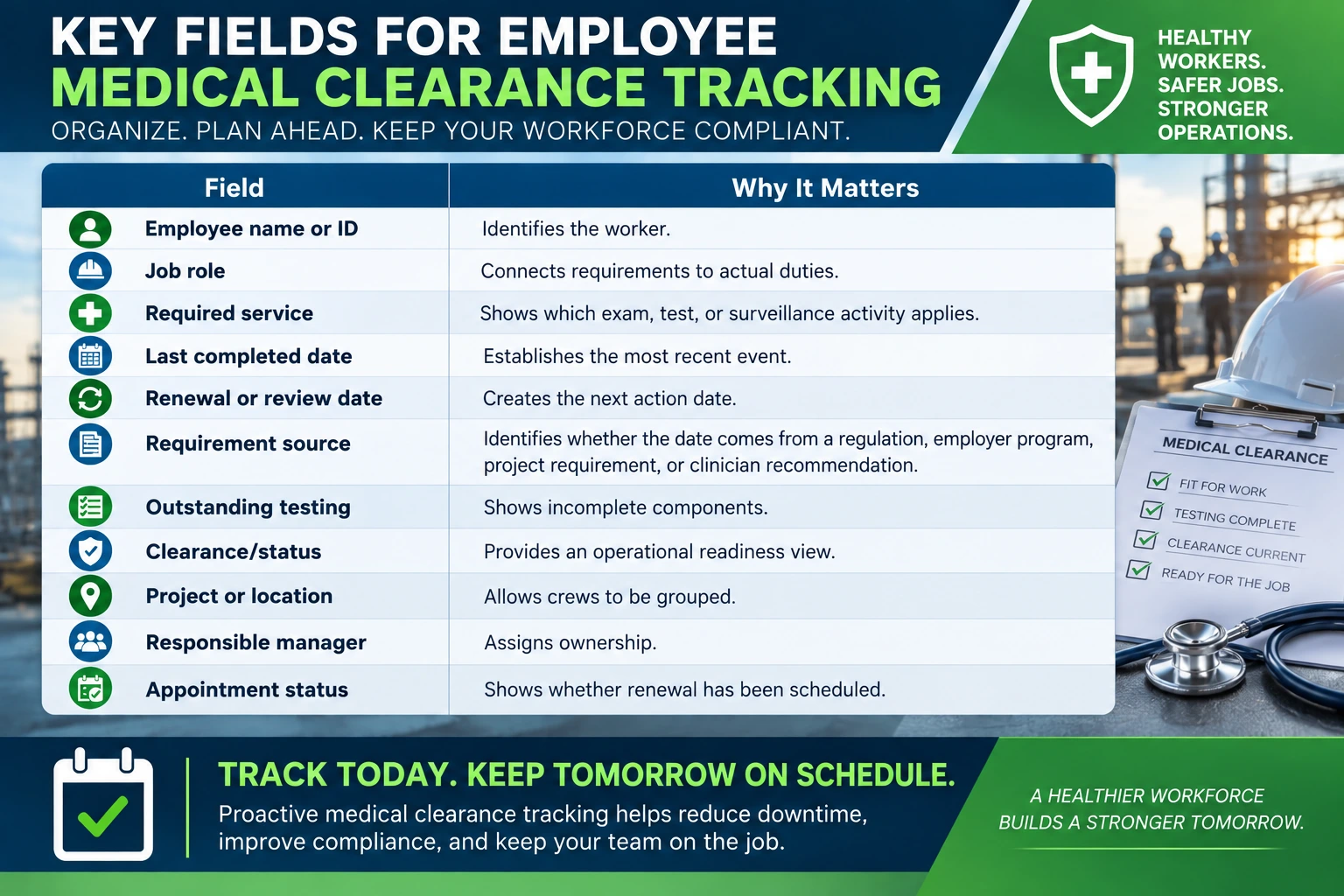
Keep the tracking system focused on the information managers genuinely need. Full clinical details should not automatically be placed in a general workforce tracker. What an employer may appropriately receive depends on the examination, applicable regulation, authorization, and other legal requirements.
For a deeper explanation of what medical clearance can mean in an occupational setting, Gulf Coast’s existing guide to medical clearance for work provides useful supporting context.
There Is No Universal Medical Clearance Expiration Period
One of the biggest mistakes in occupational health expiration tracking is assigning the same renewal cycle to every employee.
Different programs follow different rules.
Respirator Medical Evaluations
OSHA requires an employee who must use a respirator to receive a medical evaluation before fit testing or required workplace respirator use. OSHA does not simply require that medical evaluation to be repeated every year. Additional medical evaluations are required when specified circumstances indicate reevaluation is needed.
Fit testing is a separate requirement. Tight-fitting respirator users must be fit tested before initial use, when a different facepiece is used, and at least annually thereafter. Review OSHA’s Respiratory Protection Standard
That distinction is critical for tracking. An annual fit-test due date should not automatically be labeled as an annual respirator medical-clearance expiration.
Silica Medical Surveillance
For workers covered by OSHA’s construction silica medical-surveillance provisions, periodic examinations are generally required at least every three years, or more frequently when recommended by the physician or other licensed healthcare professional. Review OSHA’s respirable crystalline silica standard
Hearing Conservation
Under OSHA’s general-industry hearing-conservation requirements, covered employees exposed at or above the specified action level receive a new audiogram at least annually after the baseline audiogram. Review OSHA’s occupational noise standard
DOT Medical Certification
FMCSA states that a DOT physical may result in a medical certificate valid for up to 24 months. A medical examiner may issue certification for a shorter period when closer monitoring is appropriate. Review FMCSA’s DOT medical certification guidance
These examples show why medical surveillance renewal tracking should record the source of each renewal date instead of applying one default expiration interval across the workforce.
Use a 90, 60, and 30-Day Renewal Workflow
Once each employee has the correct requirement and due date, create staged alerts.
90 Days Before the Due Date
Use the 90-day window to verify the requirement rather than immediately booking an appointment.
Confirm:
- The employee is still assigned to the role
- The project still requires the clearance
- The governing requirement has not changed
- The employee has not already completed the service elsewhere
- Additional testing needs to be bundled with the renewal
This is also the right time to identify large groups of upcoming expirations.
60 Days Before the Due Date
Move from review to scheduling.
At this stage:
- Assign the renewal to a responsible manager
- Schedule clinic appointments where appropriate
- Group employees who need similar services
- Identify workers at remote or high-volume sites
- Determine whether mobile testing would simplify logistics
Gulf Coast currently lists physical exams, pulmonary function testing, respirator fit testing, hearing and vision testing, drug and alcohol testing, X-ray, EKG, and laboratory services among its on-site capabilities. Review Gulf Coast occupational health services
30 Days Before the Due Date
The final month should be about closing exceptions.
Flag:
- Unscheduled employees
- Missed appointments
- Incomplete testing
- Follow-up requirements
- Documentation still awaiting review
- Employees moving to a project with different requirements
Do not wait until the expiration date to discover that a follow-up examination is required.
If your organization is managing multiple medical clearances, surveillance schedules, and project deadlines, Gulf Coast Occupational Medicine can help coordinate clinic-based or mobile occupational health services around the requirements you identify.
Group Expirations by Crew, Project, and Location
A list sorted only by employee name is not enough for a project manager.
Create operational views such as:
- Expiring within 30 days
- Expiring within 60 days
- Expiring within 90 days
- Missing required testing
- Scheduled but incomplete
- Cleared for Project A
- Pending for Project B
- Baton Rouge-area employees
- Remote-site employees
- Employees requiring the same surveillance bundle
This turns employee certification expiration tracking from an HR recordkeeping task into a workforce-planning tool.
It also helps employers identify when sending employees individually to clinics makes sense and when coordinating a larger on-site event may reduce travel and scheduling friction.
Gulf Coast’s current site states that its mobile program supports occupational health services at job sites, while its Louisiana clinic locations provide options for employees who are better served through individual clinic appointments.
Preparing an Industrial Crew for Mobilization
Consider a Baton Rouge contractor preparing 75 employees for an upcoming industrial project.
The workforce includes employees who need different combinations of physical examinations, respiratory services, hearing testing, and other project-specific requirements.
Instead of checking every employee the week before mobilization, the safety team runs its medical clearance tracking report 90 days out.
The report identifies:
- Employees whose requirements are already current
- Renewals due within the next three months
- Employees missing a required service
- Employees whose next action needs clarification
- Groups that can be scheduled together
- The manager responsible for each unresolved item
At 60 days, appropriate testing is scheduled. Employees with the same requirements are grouped where practical, and the employer evaluates whether clinic visits or a mobile event better fits the crew.
At 30 days, management works only from an exception list.
The value of the workflow is not a guarantee that every worker will be medically cleared. Clinical determinations remain individualized. The benefit is knowing about unresolved requirements early enough to manage them properly.
Use a Workforce Compliance Dashboard as an Exception Tool
A useful workforce compliance dashboard should not force managers to review every employee every morning.
It should surface exceptions.
For example:
Green: Current with no known action due
Yellow: Renewal approaching
Orange: Appointment or follow-up pending
Red: Requirement overdue or incomplete
Gray: Requirement needs verification
The status definitions should be documented so every manager interprets them consistently.
Gulf Coast’s current website describes digital systems that provide visibility into compliance status, testing history, and training certifications, with access that can be organized by site, project, or company.
Employers evaluating a provider should ask what information is available, who can access it, how status changes are communicated, and how the system fits their internal process.
Questions to Ask Before Building Your Tracking Process
Before launching or rebuilding medical clearance tracking, ask:
- Which jobs actually require medical clearance or surveillance?
- What regulation, customer requirement, employer program, or clinician recommendation controls each renewal?
- Which dates represent true expiration dates versus routine review dates?
- Who owns scheduling?
- Who receives upcoming-expiration alerts?
- What happens after an employee misses an appointment?
- How will follow-up evaluations be tracked?
- Can employees be grouped by crew, project, or location?
- Can multiple services be coordinated during one scheduled visit where appropriate?
- When does mobile testing make more operational sense than individual clinic visits?
- What status information do supervisors need?
- What medical information should remain outside the manager-facing tracker?
Gulf Coast’s physicals, exams, and health surveillance services include regulatory physicals and multiple surveillance programs that employers may need to coordinate across different renewal cycles.
Build the Clearance Calendar Before the Next Mobilization
An expired medical requirement should not be discovered accidentally when a project is ready to start.
A stronger process begins with accurate requirements, individual renewal dates, 90/60/30-day alerts, clear ownership, exception reporting, and coordinated scheduling.
Gulf Coast Occupational Medicine provides occupational examinations, medical surveillance, testing, clinic services, and mobile/on-site support for employers managing workforce health requirements. Current service and location information is available through its occupational health services and clinic network.
Call (225) 753-7233 to discuss the occupational health requirements your workforce needs to track, or use the Gulf Coast Occupational Medicine contact page to discuss clinic-based or mobile service planning.
This article provides general occupational health and workforce-planning information. Specific regulatory, medical, and employment requirements should be verified for the applicable employee, exposure, job, and program.
Frequently Asked Questions
How often should employee medical clearances be renewed?
There is no universal renewal period. Timing can depend on the specific regulation, occupational-health program, project requirement, employer requirement, or clinician recommendation. Employers should track the source of each due date rather than assigning one standard interval to every employee.
Does respirator medical clearance expire every year?
OSHA does not establish a simple annual expiration rule for the respirator medical evaluation. The evaluation must occur before required respirator use or fit testing, with additional evaluations required under specified circumstances. Tight-fitting respirator fit testing, however, is required at least annually.
What should an occupational health expiration tracker include?
Track the employee, job role, required service, last completed date, next due date, source of the requirement, outstanding testing, operational status, project assignment, responsible manager, and scheduling status. Avoid using a general manager-facing tracker as a repository for unnecessary clinical details.
Can Gulf Coast Occupational Medicine provide testing at a job site?
The current Gulf Coast services page states that mobile units can provide physical examinations, pulmonary function testing, respirator fit testing, hearing and vision testing, drug and alcohol testing, X-ray, EKG, laboratory services, and other occupational-health support at project sites. Availability and the appropriate service mix should be confirmed for each employer and project.
