
New Workers Need Time to Adjust to Heat
A new employee may be physically capable of demanding industrial work and still be unprepared for a full shift in Louisiana heat. Workers who are new to hot environments, returning after time away, moving into more demanding tasks, or beginning work in heavier protective clothing may need time for their bodies to adapt. A structured heat acclimatization plan gives supervisors a practical way to increase heat exposure gradually instead of placing an unacclimatized worker into a normal workload on the first day. OSHA specifically identifies new and returning workers as needing additional precautions, close monitoring, frequent breaks, training, and gradual exposure.
For construction, petrochemical, manufacturing, transportation, and other high-heat operations, acclimatization should be part of a broader heat illness prevention process. Gulf Coast Occupational Medicine provides occupational health services for employers across Louisiana and supports industrial workforces through clinic-based, mobile, and on-site services. These medical resources can support workforce readiness, but they do not replace engineering controls, work practices, supervision, hydration, and emergency planning at the job site.
What Is Heat Acclimatization?
Acclimatization is the physiological adaptation that develops through repeated exposure to a hot environment. NIOSH explains that these adaptations can include more efficient sweating, improved circulation, lower heart rate and core temperature during work, and improved skin blood flow. The process generally develops through gradually increasing heat exposure over approximately 7 to 14 days.
This matters for new worker heat safety because employers cannot reliably determine who will tolerate heat simply by looking at age, appearance, or apparent fitness. OSHA recommends that new workers receive shorter periods of work in heat, more frequent rest breaks, training, close monitoring, and a buddy system during the acclimatization period.
How the OSHA 20 Percent Rule Works
The phrase OSHA 20 percent rule is commonly used in OSHA heat-safety outreach materials, while NIOSH provides the detailed acclimatization recommendation. For a worker without recent experience doing the job in hot conditions, NIOSH recommends no more than 20% of the usual heat exposure on the first day, followed by increases of no more than 20 percentage points on each additional day.
A practical example looks like this:
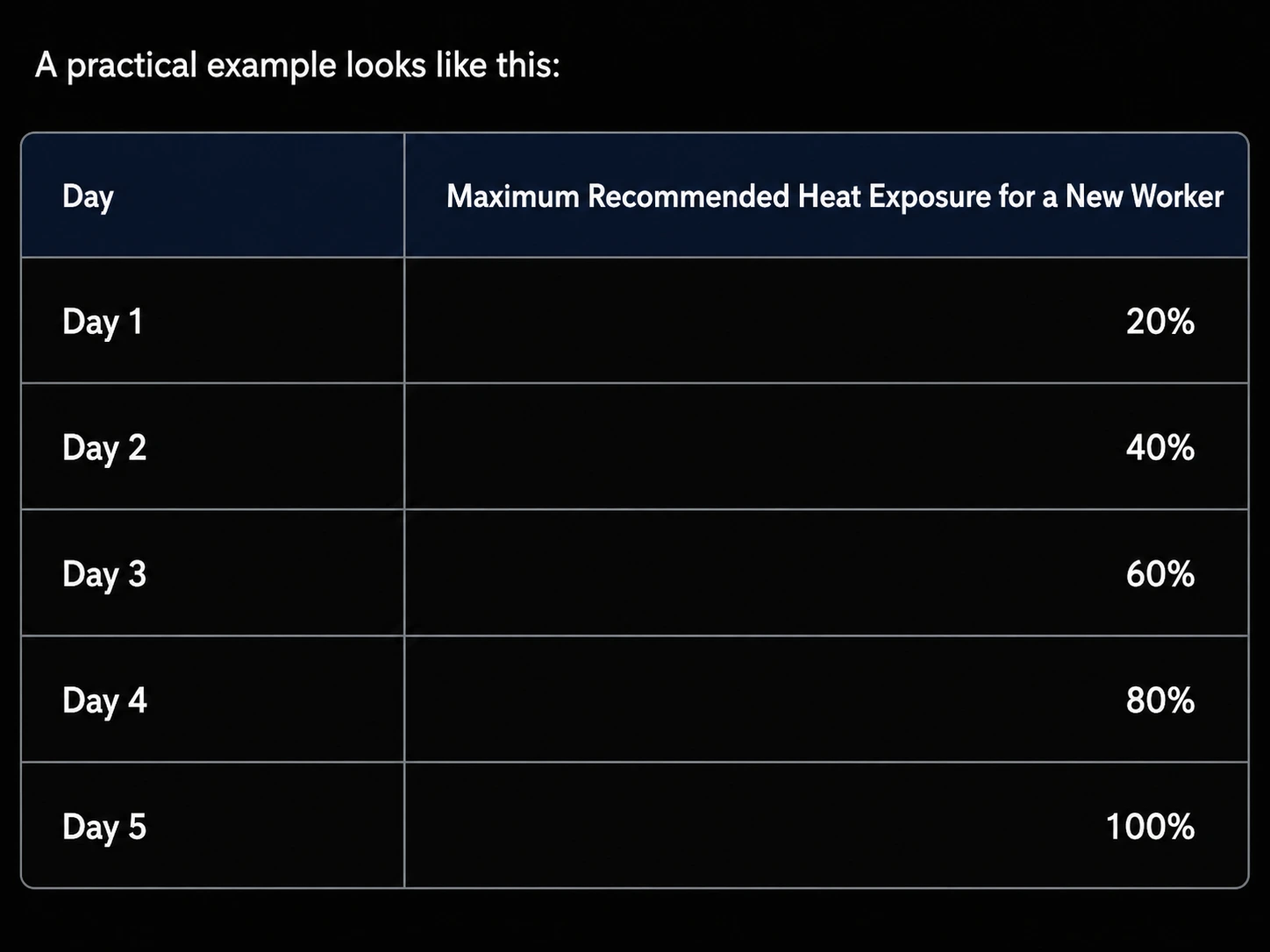
This is a gradual exposure framework, not a guarantee that the listed workload is safe under every condition. Temperature, humidity, direct sunlight, physical workload, air movement, protective clothing, PPE, and the worker’s response must still be considered when managing heat stress prevention for workers.
Workers with previous experience doing the same job may be able to reacclimatize faster. NIOSH recommends no more than 50% of usual heat exposure on day one, 60% on day two, 80% on day three, and 100% on day four. Workers away from heat exposure for a week or longer may lose a meaningful amount of acclimatization and may need gradual reacclimatization.
Importantly, as of August 2026, OSHA’s federal Heat Injury and Illness Prevention rule remains in the rulemaking process rather than being a finalized heat-specific federal standard. Employers should distinguish current OSHA and NIOSH prevention guidance from proposed requirements and should monitor the OSHA heat rulemaking for changes. OSHA also updated its National Emphasis Program for indoor and outdoor heat hazards in April 2026.
Build Acclimatization Into the Heat Illness Prevention Program
A heat acclimatization plan should not operate as a stand-alone scheduling document. It should connect directly to the employer’s broader heat illness prevention program.
Before a new or returning employee begins heat-exposed work, supervisors should identify who requires acclimatization, establish the planned exposure progression, provide access to cool drinking water and recovery areas, assign appropriate supervision, and explain how workers should report symptoms.
NIOSH recommends a buddy system, readily accessible potable water, worker and supervisor training, and adjustments to work and recovery time based on changing conditions. For moderate activity in heat lasting less than two hours, NIOSH recommends about one cup of water every 15 to 20 minutes. Longer periods of sweating may also require electrolyte replacement.
Employers developing a broader workforce-readiness strategy can also review Gulf Coast Occupational Medicine’s occupational health services and construction occupational health guidance. GCOM currently supports industrial employers with physical examinations, testing, injury care, medical services, and other occupational health resources.
Adjust the Plan for Real Job-Site Conditions
The same schedule will not fit every employee or work environment. Work-rest cycles for heat should become more protective as heat, humidity, solar exposure, workload, and protective clothing increase. NIOSH also recommends longer or more frequent recovery periods when air movement is limited, work becomes heavier, or protective equipment adds additional heat burden.
Heavy Physical Labor
Workers performing strenuous construction, maintenance, material handling, or other high-metabolic tasks produce additional internal heat. Supervisors may need to reduce time performing the most demanding tasks, rotate work where appropriate, and increase recovery opportunities.
PPE and Protective Clothing
Respirators, impermeable clothing, gloves, boots, and other equipment can restrict heat loss and increase physical effort. PPE that is required for another workplace hazard should not simply be removed to manage heat. Instead, employers should account for its additional heat burden when establishing exposure and recovery schedules.
Indoor Heat
Heat illness prevention is not limited to outdoor construction. Indoor operations with ovens, furnaces, hot processes, poor air movement, or inadequate climate control can also expose workers to hazardous heat. OSHA recommends evaluating both indoor and outdoor heat hazards.
Long Shifts and Heat Waves
For 10 or 12-hour shifts, employers should not interpret the 20% recommendation as permission to expose a new worker to a predetermined number of hours regardless of conditions. Actual heat exposure, workload, breaks, PPE, and environmental conditions still matter. Sudden heat waves may also require additional precautions for the entire workforce, including workers who normally tolerate their jobs well. NIOSH recommends using a heat-alert program when hot weather is forecast.
If your operation is planning a large mobilization, turnaround, or high-heat project, Gulf Coast Occupational Medicine can help employers evaluate whether clinic-based or mobile occupational health services fit their workforce needs. The current website also lists Heat Stress among available safety-training topics through the broader NuREADY Health Network.
Hypothetical Example: A Baton Rouge Industrial Crew
Hypothetical scenario: A Baton Rouge industrial contractor hires 20 workers before a summer project involving physically demanding outdoor work, required PPE, and extended shifts.
Instead of putting every new hire into the normal production schedule immediately, the safety team identifies which workers are new to the heat-exposed work and begins a gradual acclimatization schedule. Supervisors pair workers through a buddy system, establish water and cooling locations, adjust work-rest cycles for heat, and check workers throughout the shift.
If a heat wave develops during the first week, the supervisor does not continue the schedule automatically. Workload, environmental conditions, PPE, and recovery periods are reassessed. This approach turns new worker heat safety into an operational process rather than a one-time orientation topic.
Know When Heat Symptoms Become an Emergency
Employees and supervisors should be trained to recognize symptoms and respond quickly. OSHA identifies confusion, slurred speech, loss of consciousness, and seizures as warning signs of possible heat stroke. Heat stroke is a medical emergency. Employers should call 911 immediately, begin appropriate cooling, and stay with the worker until emergency help arrives. Routine occupational clinic care should never delay emergency treatment for suspected heat stroke or another potentially life-threatening condition.
Less severe symptoms should still be taken seriously, particularly during the first days of heat exposure. A heat illness prevention program should clearly define who stops work, who provides first aid, how medical assistance is requested, and how the incident is documented.
Prepare Your Workforce for High-Heat Operations
An effective heat acclimatization plan combines gradual exposure with supervision, hydration, cooling opportunities, appropriate work-rest cycles for heat, symptom recognition, and an established emergency response procedure. Employers should also review their plan when workloads, PPE, weather, staffing, or job-site conditions change.
Gulf Coast Occupational Medicine supports Louisiana employers with occupational health services, workplace injury care, examinations, testing, mobile medical services, and on-site workforce support. Employers can also review current Gulf Coast Occupational Medicine locations when planning clinic-based services. Call (225) 753-7233 to discuss occupational health or mobile/on-site support for your workforce.
Heat programs should be tailored to actual workplace hazards and current requirements. Employers should consider review by qualified safety and occupational health professionals when developing or updating a program.
Frequently Asked Questions
What is the OSHA 20 percent rule for heat?
The OSHA 20 percent rule refers to gradually introducing new workers to full-intensity work in heat. NIOSH recommends no more than 20% of usual heat exposure on day one, increasing by no more than 20 percentage points on subsequent days. This is prevention guidance and should be adapted to workplace conditions.
How long does heat acclimatization take?
NIOSH recommends gradually increasing exposure over approximately 7 to 14 days. Individual adaptation can vary based on the worker, workload, environment, and total heat stress.
Do returning workers need to acclimatize again?
Potentially. NIOSH states that workers away from heat exposure for a week or more may lose some beneficial adaptations and may require gradual reacclimatization.
Does acclimatization replace water and rest breaks?
No. Acclimatization is only one component of heat stress prevention for workers. Employers should also consider water, recovery periods, cooling areas, training, supervision, engineering and administrative controls, and emergency procedures.
