
Not Every Emergency Responder Belongs in the Same Medical Program
An employee listed on an emergency plan is not automatically a member of an organized HAZMAT team. That distinction matters because an emergency response team’s physical and ongoing medical surveillance should be based on the employee’s actual duties, potential hazardous-substance exposure, respirator requirements, and the OSHA standard that applies.
OSHA defines a HAZMAT team as an organized group designated by the employer to handle and control actual or potential hazardous-substance leaks or spills that may require close approach to the substance. Members of these designated teams are specifically included in HAZWOPER medical surveillance requirements. Review OSHA’s HAZWOPER standard
For employers coordinating industrial workforce examinations, Gulf Coast Occupational Medicine provides occupational health services for industrial employers and currently lists ERT physicals, HAZMAT physicals, health surveillance, respiratory services, and mobile/on-site capabilities among its offerings.
The practical first step is therefore not simply scheduling everyone for the same exam. Employers should first determine who is actually covered and why.
Who May Need an ERT Physical Exam or Medical Surveillance?
Under OSHA’s HAZWOPER standard, several employee categories can fall within the medical surveillance provisions of 29 CFR 1910.120(f). These include certain employees with qualifying hazardous-substance exposure, employees who wear a respirator for 30 or more days per year or as required by the Respiratory Protection Standard, employees with exposure-related illness or symptoms, and members of HAZMAT teams.
For organized HAZMAT teams specifically, OSHA 1910.120(q)(9) requires members to receive a baseline physical examination and medical surveillance under paragraph (f). OSHA’s broader Medical Screening and Surveillance Requirements Guide also summarizes HAZWOPER as including preplacement, periodic, emergency/exposure, and certain termination examinations for covered workers.
That does not mean every employee who participates in a fire drill, evacuation, spill-reporting procedure, or incidental-release response automatically becomes a HAZMAT-team member.
OSHA has explained that employees expected to respond as part of an organized team to broader hazardous-substance releases may fall within the HAZMAT-team provisions, while an employee dealing only with an incidental release in the employee’s immediate work area would not become a HAZMAT-team member on that basis alone. Review OSHA’s HAZMAT-team interpretation
For employers, the job description and emergency-response plan should therefore match what workers are actually expected to do.
What Should the Baseline Medical Evaluation Cover?
For HAZWOPER-covered employees subject to the periodic surveillance requirements, examinations are provided prior to assignment and generally at least once every 12 months. The attending physician may determine that a longer interval is appropriate, but OSHA limits that interval to no more than biennial for the applicable groups.
The standard does not create one universal list of laboratory tests or imaging studies that every employee must receive.
OSHA’s surveillance guidance explains that the medical and work history should emphasize symptoms related to hazardous-substance handling, fitness for duty, and the ability to wear required personal protective equipment. Examination content, additional tests, chest imaging, and pulmonary testing can depend on the physician’s determination and the employee’s exposures and responsibilities.
That is an important distinction when developing an ERT physical exam protocol. The employer should provide the occupational health provider with enough job information to understand:
- Emergency-response duties
- Anticipated hazardous substances or exposures
- PPE and respirators employees may use
- Physical demands of the role
- Applicable medical-surveillance standards
- Relevant previous occupational-health information where appropriate
GCOM’s current physical exams and health surveillance services specifically list ERT and HAZMAT physicals along with occupational surveillance services. Employers should still make sure the requested protocol reflects their own hazard assessment and applicable requirements rather than assuming every ERT needs an identical examination.
Respirator Clearance Is a Separate Requirement to Track
Emergency-response personnel frequently use respiratory protection, including equipment intended for higher-risk environments. Respirator use brings its own medical-evaluation requirements.
Under OSHA’s Respiratory Protection Standard, an employer must provide a medical evaluation to determine an employee’s ability to use a respirator before the employee is fit tested or required to use the respirator in the workplace. Additional medical evaluations may be required when symptoms, recommendations from a PLHCP or program administrator, program observations, or workplace changes indicate a need. Review OSHA’s Respiratory Protection Standard
Medical evaluation and fit testing should not be treated as the same task. OSHA requires medical clearance first, while tight-fitting respirator fit testing has its own initial and recurring requirements. GCOM’s OSHA respirator medical evaluation guide provides additional employer-focused context on keeping those steps separate.
Coordinate the Exam Before the Assignment Begins
If employees are being added to an organized emergency-response or HAZMAT team, schedule the applicable occupational medical evaluation before the assignment begins rather than waiting until a project or emergency-response deadline approaches.
Gulf Coast Occupational Medicine can help employers coordinate ERT physicals, HAZMAT examinations, respiratory evaluations, fit testing, and related occupational health services through clinic-based and mobile/on-site options. Current service availability should be confirmed for the specific workforce and examination protocol. Explore GCOM occupational health services
Do Not Stop Tracking After the Baseline Exam
A strong emergency response medical surveillance program needs more than a completed baseline physical.
Employers should track periodic surveillance dates, respirator evaluation status, job-assignment changes, potential hazardous-substance exposures, clinician documentation, and employees who leave or transfer out of covered assignments.
HAZWOPER also requires additional medical consultation for covered exposure situations. OSHA states that emergency response employees who exhibit signs or symptoms that may have resulted from hazardous-substance exposure during an emergency incident must receive medical consultation under the applicable provisions.
This means an annual renewal calendar alone is not enough. The employer also needs an event-driven process for potential exposure.
Employer Checklist for Emergency Response Medical Surveillance
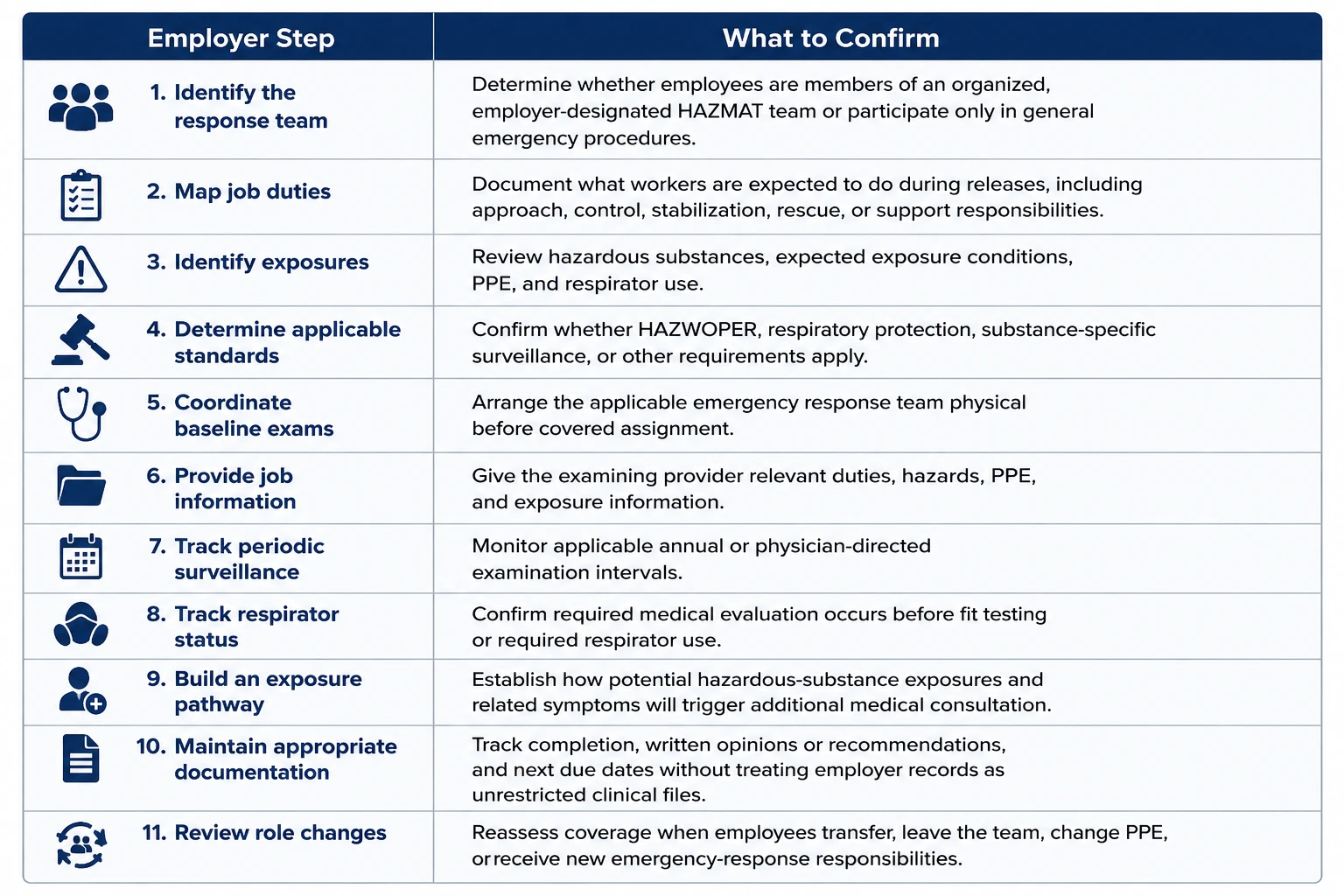
Industrial HAZMAT Team
A Baton Rouge-area industrial employer designates 18 employees as an organized HAZMAT team. Their responsibilities include approaching and controlling certain hazardous-substance releases, and the roles require respiratory protection.
Before assigning employees to the team, the employer maps the job duties, hazards, PPE, and applicable HAZWOPER and respiratory-protection requirements. Workers complete the appropriate baseline occupational evaluation and respirator medical evaluation.
The employer then records surveillance renewal dates, fit-testing status, responsible managers, and the procedure for obtaining additional medical evaluation if a team member experiences a potential hazardous-substance exposure or develops relevant symptoms.
This process is different from adding employees to a general evacuation roster. The medical-surveillance decision follows the worker’s actual emergency-response responsibilities and applicable standard.
For Louisiana employers managing employees across several sites, GCOM currently operates multiple clinics and mobile capabilities. Employers can review Gulf Coast Occupational Medicine locations when deciding whether clinic-based or on-site scheduling better fits the workforce.
Build the Medical Process Around the Response Role
An emergency response team physical should be part of a broader employer process that starts with the response plan, job duties, hazardous-substance exposures, PPE, and applicable regulations.
For organized HAZMAT teams, that process may include baseline and periodic medical surveillance, respirator medical evaluations, occupational-health documentation, renewal tracking, and additional evaluation after qualifying exposure events. Employers should review the complete OSHA standards applicable to their workforce rather than treating one generic “HAZMAT physical” as sufficient for every situation.
Gulf Coast Occupational Medicine currently provides ERT and HAZMAT physicals, respiratory services, medical surveillance, diagnostics, and mobile/on-site occupational health support. Call Gulf Coast Occupational Medicine at (225) 753-7233 to discuss an emergency-response or HAZMAT medical-surveillance program for your workforce. The current main number is listed on GCOM’s locations page.
Frequently Asked Questions
Does every member of an emergency response team need a HAZMAT physical?
Not automatically. Employers need to identify the employee’s actual response duties and the standard that applies. Members of an organized and designated HAZMAT team are specifically covered by HAZWOPER medical surveillance, while employees involved only in general emergency procedures may fall under different requirements.
How often do HAZMAT-team members need medical examinations?
For applicable employees covered by HAZWOPER paragraph (f)(2), examinations are provided before assignment and at least every 12 months unless the attending physician determines a longer interval is appropriate, not greater than biennial. Other examinations may also be triggered by exposure, symptoms, termination, or reassignment depending on the provision.
Does an ERT physical automatically include a chest X-ray or pulmonary function test?
Not as a universal OSHA requirement under HAZWOPER. OSHA’s surveillance guidance indicates that chest X-rays, pulmonary function testing, and other tests under HAZWOPER may depend on the examining physician’s determination. Employers should build the examination protocol around the applicable hazard, role, PPE, and medical-surveillance requirements.
Is respirator fit testing part of the medical evaluation?
No. OSHA treats medical evaluation and fit testing as separate requirements. The medical evaluation must occur before an employee is fit tested or required to use a respirator. Tight-fitting respirators then have their own fit-testing requirements.
