
Treating Every Workplace Drug Test the Same Can Create the Wrong Process
One of the easiest ways to create a drug-testing problem is to send an employee for “a drug test” without first identifying which program actually applies. A CDL driver performing a covered safety-sensitive function may need a federally regulated DOT test, while a mechanic, warehouse employee, or office worker at the same company may fall under a separate non-DOT employer program.
That distinction should be made before the collection is ordered. For employers managing both types of workers, DOT vs non-DOT drug testing affects who is covered, why testing occurs, which rules apply, which forms are used, how random pools are organized, who receives results, and what happens after a violation.
Gulf Coast Occupational Medicine currently provides drug and alcohol testing among its employer-focused occupational health services and offers clinic-based as well as mobile/on-site options for workforces.
DOT Testing Is a Federal Regulatory Program
DOT testing is not simply a company drug test performed for a transportation employee.
The U.S. Department of Transportation’s 49 CFR Part 40 establishes the procedures used for federally required transportation drug and alcohol testing. Individual DOT agencies then determine which employees are covered and when testing is required within their industries. Department of Transportation
For motor carriers, for example, FMCSA states that CDL drivers operating commercial motor vehicles subject to CDL requirements on public roads are generally performing safety-sensitive functions covered by DOT drug and alcohol testing requirements. This includes full-time, part-time, intermittent, and backup drivers when they perform covered functions. FMCSA
Employers with transportation operations can review the official FMCSA guidance on who must be tested before deciding which workers belong in a regulated testing program.
Non-DOT Workplace Drug Testing Follows a Different Authority
A non-DOT workplace drug testing program operates under the employer’s own authority rather than DOT Part 40, subject to applicable federal, state, and local laws, collective bargaining requirements where relevant, and the employer’s written policy.
SAMHSA notes that state and local laws can affect who may be tested, how testing is conducted, and what employment consequences may follow. Requirements are not uniform across every state.
Louisiana also has its own statutory framework for workplace drug testing. Louisiana Revised Statutes Chapter 14 contains definitions, testing requirements, and applicability provisions, including exclusions for certain federally mandated testing programs and specified industries. Employers should confirm how current Louisiana law applies to their specific non-DOT workforce rather than assuming DOT procedures govern every employee. Legislative Website
For Louisiana-specific programs, review the Louisiana Legislature’s current drug-testing provisions and obtain appropriate legal guidance when policy interpretation is needed.
DOT and Non-DOT Tests Must Stay Separate
This is one of the most important operational rules for employers with mixed workforces.
DOT §40.13 states that DOT drug and alcohol tests must be completely separate from non-DOT tests. DOT testing must take priority when both are being performed, and employers cannot use DOT forms for non-DOT testing. DOT testing also cannot be conducted on someone who is not a DOT-regulated employee. Department of Transportation
The practical lesson is simple:
Do not send a collection site a vague request that says only “drug screen.”
The order should make clear whether the test is:
- DOT or non-DOT
- Which DOT agency applies, when regulated
- What testing reason applies
- Which employee or job category is being tested
- Which employer account or program the result belongs to
Employers can review the official DOT rule on separating DOT and non-DOT tests when building their internal procedures.
DOT vs Non-DOT Drug Testing at a Glance
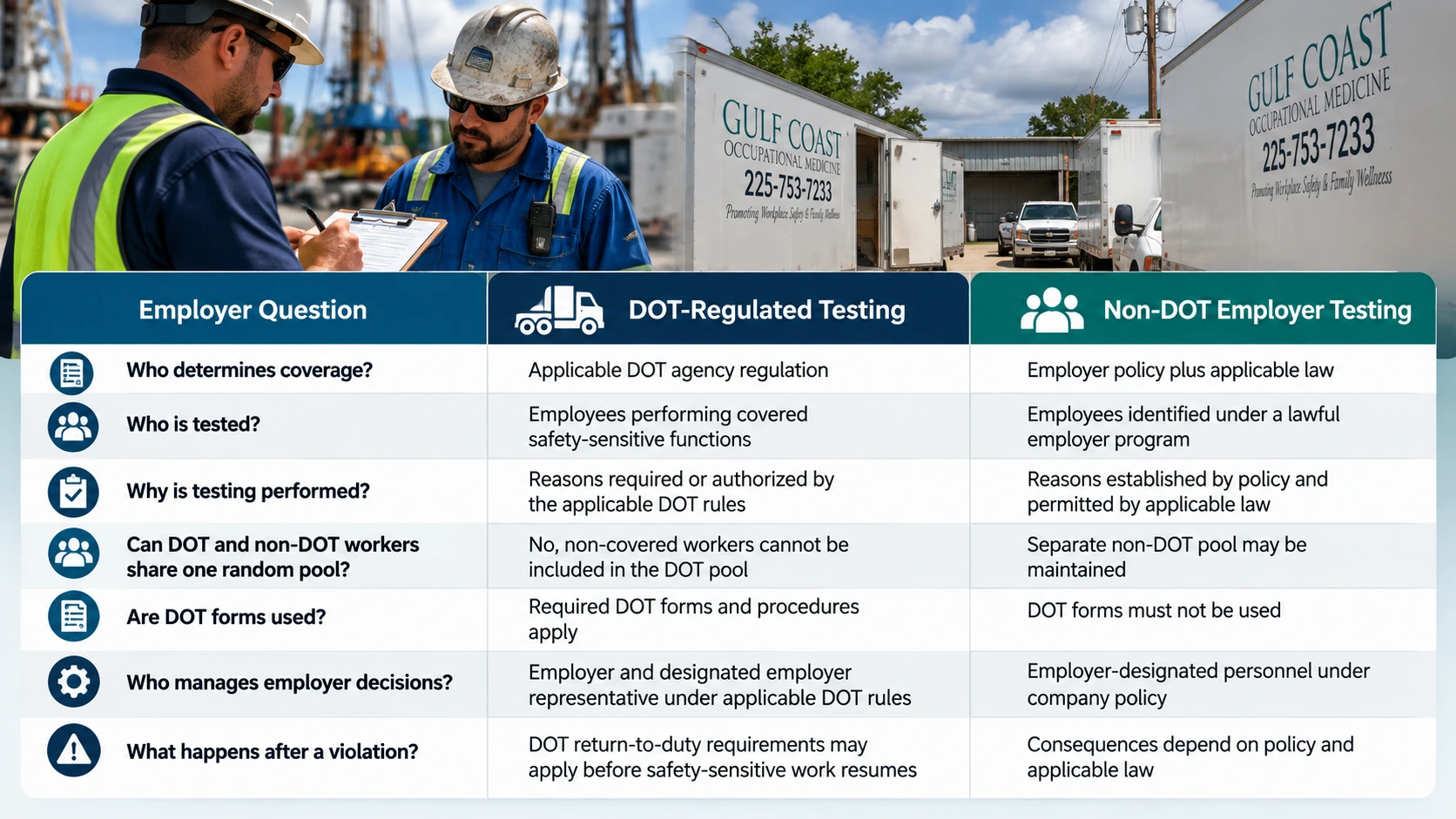
FMCSA specifically states that non-CDL drivers cannot be placed into an FMCSA DOT random-testing pool simply because the employer also chooses to test them. FMCSA
The DER Has a Specific Role in DOT Testing
Employers operating a DOT program should identify their Designated Employer Representative, or DER.
Under Part 40, the DER is an employee authorized to receive results, make required decisions in the testing process, and take immediate action when a covered employee must be removed from safety-sensitive duties. A service agent cannot act as the employer’s DER. Department of Transportation
Even when an occupational-health provider, collection site, consortium, or other service agent performs parts of the testing process, the DOT makes clear that the employer remains responsible for meeting its regulatory obligations.
Before Your Next Testing Event, Verify the Program First
If your organization employs CDL drivers alongside mechanics, technicians, warehouse staff, supervisors, or administrative employees, review your testing categories before the next pre-employment test, random selection, post-accident event, or other testing request.
Gulf Coast Occupational Medicine currently provides workplace drug and alcohol testing and can coordinate services through its clinics and mobile units. Review GCOM’s occupational health and testing services, then discuss how your workforce should be routed between the appropriate testing programs.
One Employer, Four Employee Groups
A Louisiana employer has 12 CDL drivers, 20 mechanics, 35 warehouse employees, and eight administrative employees.
The company’s covered CDL drivers operate commercial motor vehicles requiring CDLs. Those employees are placed in the appropriate FMCSA-regulated DOT program.
The mechanics and warehouse employees are not automatically DOT-regulated simply because they work for the same company. If the employer chooses to test those groups under company policy, those tests are handled separately as non-DOT testing, subject to applicable law and policy.
Administrative employees may have a different testing policy again, depending on the employer’s program.
The employer therefore creates separate employee lists, clearly identifies the test type on every order, keeps the DOT random pool separate, and designates the appropriate internal contact for results and follow-up.
This is mixed workforce drug testing done intentionally instead of assuming one program fits every employee.
Testing Reasons Also Need to Match the Correct Program
Terms such as pre-employment, random, post-accident, reasonable suspicion, return-to-duty, and follow-up appear frequently in workplace testing, but employers should not assume the same rules apply in every program.
For DOT-covered employees, the applicable DOT agency regulations determine testing requirements. Non-DOT employers need to look to company policy and applicable law.
GCOM’s guide to random drug testing vs reasonable suspicion testing provides additional context on how two common testing reasons differ. Employers in construction can also review GCOM’s Louisiana construction drug-testing guide, which specifically discusses separating regulated drivers from other workers.
Protect the Testing Order Before the Employee Arrives
A useful employer process starts before collection.
For each test, HR, safety, fleet management, or the DER should be able to identify:
- The employee’s actual job and safety-sensitive duties.
- Whether a DOT agency regulation covers that employee.
- The correct testing reason.
- Whether the request is DOT or non-DOT.
- The correct employer program or random pool.
- The authorized person who should receive appropriate results.
- What policy or regulatory process applies after the result.
- Whether mobile or clinic-based collection is more practical for the workforce.
That simple verification step can reduce avoidable routing, documentation, and program-management errors.
Build Two Clear Programs Instead of One Ambiguous One
The strongest DOT vs non-DOT drug testing process is not the one with the most tests. It is the one where employers know exactly which employee belongs in which program before testing begins.
For DOT-regulated transportation workers, Part 40 and the applicable agency rules establish the federal process. For non-DOT workers, employers must consider their written policy along with applicable state, local, and federal requirements. SAMHSA recommends reviewing state and local laws because workplace drug-testing rules can differ substantially by jurisdiction.
Gulf Coast Occupational Medicine currently provides drug and alcohol testing through multiple Louisiana clinics and mobile/on-site occupational health services. Employers can review current Gulf Coast Occupational Medicine locations when deciding how to route individual employees or larger testing groups.
Before your next hiring cycle, random selection, project mobilization, or testing event, make sure every employee is assigned to the correct program. Call Gulf Coast Occupational Medicine at (225) 753-7233 to discuss workplace drug and alcohol testing for your organization and determine the appropriate clinic or mobile-service setup.
Frequently Asked Questions
What is the main difference between DOT and non-DOT drug testing?
DOT testing is federally regulated and follows Part 40 plus the rules of the applicable DOT agency. Non-DOT testing is conducted under employer authority and must follow the employer’s policy and applicable laws. Department of Transportation
Can non-DOT employees be included in a DOT random testing pool?
No. FMCSA states that employees who are not covered by its DOT testing requirements cannot be placed in the FMCSA DOT random pool. An employer may maintain a separate non-DOT testing program when permitted.
Can a company perform both DOT and non-DOT testing?
Yes, but the programs need to remain separate. DOT §40.13 requires DOT testing to remain completely separate from non-DOT testing and prohibits using DOT forms for non-DOT programs.
Does Louisiana law matter for non-DOT workplace testing?
Yes. Employers should evaluate applicable Louisiana law when developing non-DOT policies. Louisiana’s drug-testing statutes include their own definitions, procedures, and applicability provisions, while SAMHSA notes that state and local laws can significantly affect workplace testing programs.
