
A DOT Violation Starts a Defined Employer Process
When a DOT-regulated employee has a drug or alcohol violation, the next step is not simply scheduling another test. DOT return-to-duty testing is one part of a larger process under 49 CFR Part 40 that involves the employer or Designated Employer Representative, a qualified Substance Abuse Professional, the employee, testing personnel, and, for drug testing, a Medical Review Officer.
For transportation employers managing safety-sensitive employees, understanding where each responsibility begins and ends can prevent procedural mistakes. Gulf Coast Occupational Medicine provides employer-focused occupational health services that include drug and alcohol testing through clinic-based and mobile/on-site capabilities. The employer, however, remains responsible for its DOT program and employment decisions.
This guide provides general compliance information and is not individualized legal advice.
DOT Return-to-Duty Testing Employer Checklist
1. Remove the Employee From Safety-Sensitive Functions
Once an employer receives a verified positive DOT drug test, a qualifying refusal, an alcohol result of 0.04 or greater, or another DOT drug and alcohol regulation violation, the employee cannot continue performing covered safety-sensitive duties.
49 CFR 40.23 requires immediate removal after specified verified results. Employers should not wait for a written report or split-specimen testing before taking the required action after receiving the verified result. Review DOT employer actions under 49 CFR 40.23
The DER is especially important here. DOT defines the DER as an employee authorized to receive results, remove employees from safety-sensitive functions, and make required employer decisions. A testing provider or other service agent cannot act as the employer’s DER.
2. Provide Information About Qualified SAPs
The next step in the SAP return to duty process is not the return-to-duty drug test.
Under 49 CFR 40.287, the employer must provide an employee who has violated a DOT drug or alcohol regulation with a list of readily available and acceptable qualified SAPs. This obligation applies even if the employer does not intend to retain the employee. Review the DOT SAP referral requirement
DOT does not universally require the employer to pay for the SAP evaluation, education, or treatment. Payment can depend on employer policy, benefits, collective bargaining agreements, or other arrangements. If the employer intends to allow the employee to return to covered safety-sensitive duties, however, it must ensure the required SAP process is completed.
3. Allow the SAP to Control the Clinical Evaluation
The qualified SAP conducts the initial evaluation and determines what education and/or treatment is appropriate. The employer, clinic, MRO, supervisor, or employee does not substitute its judgment for the SAP’s professional recommendation.
DOT reinforced this separation in a March 2026 notification describing the SAP as the “gatekeeper” of the federal return-to-duty process and reminding employers and SAPs to follow the required Part 40 procedures. Review DOT’s 2026 SAP and return-to-duty notification
The employee then completes the education and/or treatment recommended by the SAP.
4. Wait for the SAP Follow-Up Evaluation
Completion of a class or treatment program alone does not authorize a return-to-duty test.
The SAP conducts a follow-up evaluation to determine whether the employee has successfully complied with the recommendations. When successful compliance is established, the SAP provides the appropriate written report to the DER.
If the SAP determines that the employee has not successfully complied, the employer must not return that individual to safety-sensitive duties.
5. Employer Authorizes the Return-to-Duty Test
Only after the SAP has determined successful compliance can the employer move to the actual return-to-duty drug test or alcohol test.
Under 49 CFR 40.305, if the employer decides it wants to permit the employee to resume safety-sensitive functions, it must ensure that the required test occurs. The employee must receive a negative drug-test result and/or an alcohol result below 0.02 before resuming covered safety-sensitive duties. Review 49 CFR 40.305 return-to-duty requirements
A successful SAP determination and acceptable test result make the employee eligible under the federal process. They do not require the employer to reinstate the employee. The employment decision belongs to the employer, subject to applicable agreements or other legal requirements.
Keep the Roles Separate
A useful employer workflow assigns responsibility clearly:
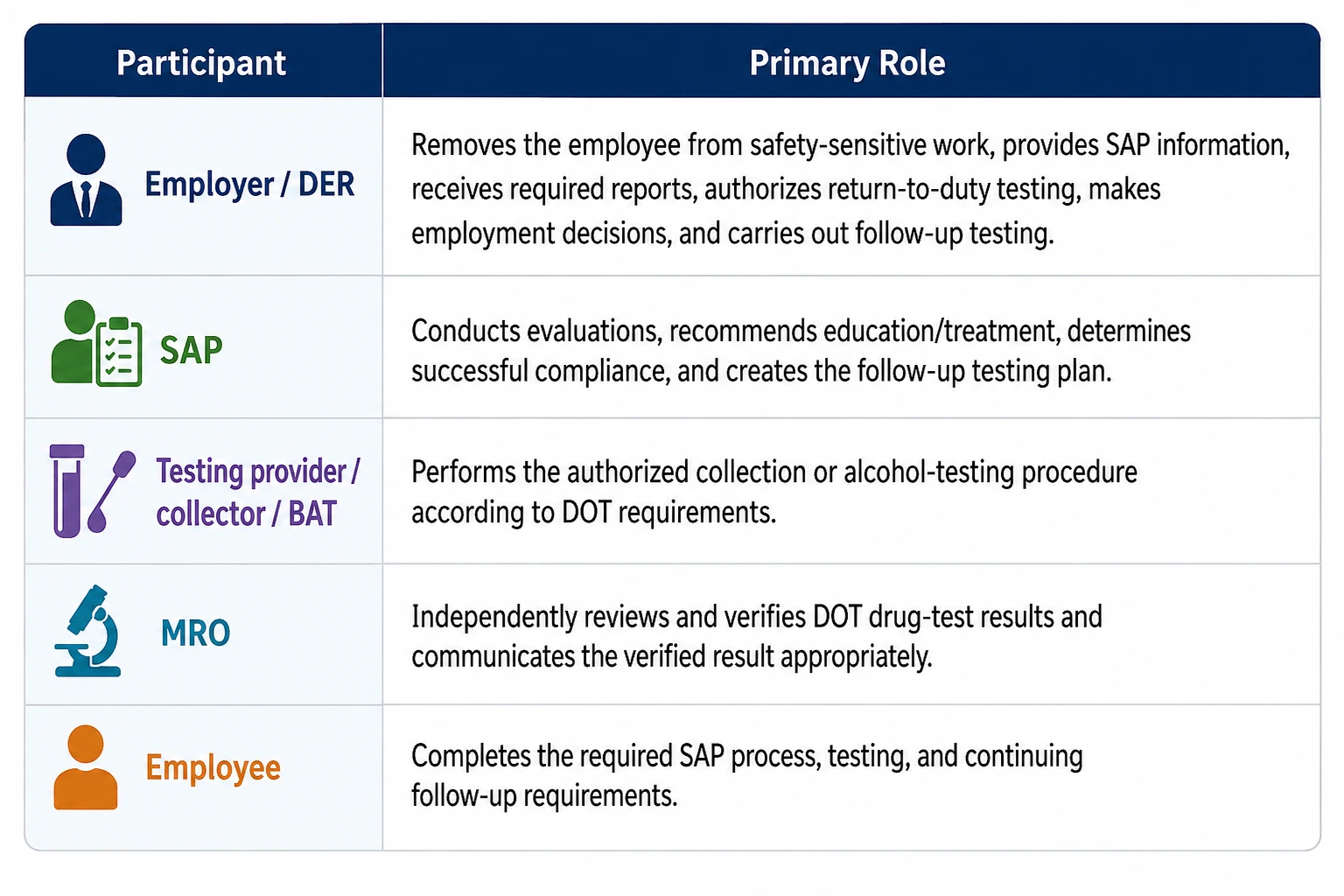
Employers wanting a deeper explanation of drug-result verification can review GCOM’s guide to what an MRO does after a positive drug test. The article explains how laboratory findings, MRO verification, and employer reporting remain separate steps.
If your organization needs help coordinating employer-directed drug and alcohol testing, Gulf Coast Occupational Medicine’s occupational health services include workplace drug and alcohol testing and mobile/on-site capabilities. Employers should confirm the specific testing, MRO, and service-agent arrangement required for their program.
Return-to-Duty and Follow-Up Drug Tests Require Direct Observation
For DOT drug testing, Part 40 requires return-to-duty and follow-up collections to be conducted under direct observation.
Current 49 CFR 40.67 specifically directs employers to require direct observation when the drug-test reason is return-to-duty or follow-up. Employers should make sure the collection site knows the test reason and is prepared to follow the current DOT direct-observation procedure. Review DOT’s direct-observation requirements
As of the latest SAMHSA laboratory list available in July 2026, there were still no HHS-certified laboratories approved for federal oral-fluid drug testing, so employers should verify current specimen availability before changing their DOT collection procedures.
DOT Follow-Up Testing Continues After the Employee Returns
A negative return-to-duty result does not end the process.
The SAP develops the DOT follow-up testing plan. At minimum, the plan must require six unannounced follow-up tests during the first 12 months of safety-sensitive duty after the employee returns. The SAP may require additional testing and may extend the follow-up period for as long as 60 months.
The employer then carries out the plan. Follow-up tests must remain unannounced and should not follow a predictable pattern. Random tests or other required tests cannot simply be substituted for SAP-directed follow-up tests.
The SAP determines the number and frequency. The employer handles scheduling and execution.
Keep DOT and Non-DOT Company Procedures Separate
An employer may also have a company policy for employees who are not covered by DOT testing regulations, but those procedures should not be treated as DOT tests.
49 CFR 40.13 requires DOT and non-DOT tests to remain completely separate. DOT forms cannot be used for non-DOT testing, and a non-DOT result cannot override a DOT result. Review DOT and non-DOT separation requirements
GCOM’s construction drug-testing guide also explains why employers managing mixed workforces should distinguish federally regulated employees from workers covered only by company policy.
A Louisiana Transportation Employer
A Louisiana employer receives a verified positive DOT drug-test result for an employee performing covered safety-sensitive transportation duties.
The DER removes the employee from safety-sensitive functions and provides SAP information. The employee completes the initial SAP evaluation and the recommended education or treatment. The SAP later conducts the follow-up evaluation and determines successful compliance.
The employer decides it is willing to consider returning the employee to the safety-sensitive position and authorizes DOT return-to-duty testing. The required drug collection is performed under direct observation. After the employer receives the required negative result, it decides whether to return the employee to the position.
The SAP’s follow-up testing plan then begins, and the employer is responsible for carrying it out as directed.
The occupational health clinic can perform or coordinate appropriate testing services, but it does not replace the SAP, control the SAP’s clinical determination, or make the employer’s personnel decision.
Build the Return-to-Duty Workflow Before a Violation Occurs
A clear DOT return-to-duty testing process helps employers know who should act, what documentation is needed, when testing may occur, and which decisions belong to the SAP, MRO, testing provider, and DER.
Gulf Coast Occupational Medicine provides workplace drug and alcohol testing and employer-focused occupational health services through Louisiana clinics and mobile/on-site capabilities. Call Gulf Coast Occupational Medicine at (225) 753-7233 to discuss workplace drug and alcohol testing services and how testing can be coordinated for your DOT-regulated workforce. The current main number is confirmed on GCOM’s contact and locations pages.
Frequently Asked Questions
Can an employee schedule a DOT return-to-duty test on their own?
The required test cannot occur until the SAP determines successful compliance and the employer decides to move forward with the return-to-duty process. Under Part 40, the employer must ensure the required return-to-duty test occurs before allowing safety-sensitive work to resume.
Does a negative return-to-duty test guarantee that an employee gets the job back?
No. A negative drug result or qualifying alcohol result satisfies a required testing condition, but the employer is not required by Part 40 to reinstate the employee. The final employment decision remains with the employer, subject to other applicable requirements.
How many DOT follow-up tests are required?
The SAP must require at least six unannounced tests during the first 12 months of safety-sensitive duty after return. The SAP may require more and may extend the plan for up to 60 months.
Are DOT return-to-duty and follow-up drug tests directly observed?
Yes. Current Part 40 requires direct observation for return-to-duty and follow-up drug tests. Employers are responsible for ensuring the collection is conducted according to the applicable DOT procedure.
