
Starting a New Prescription Before Your DOT Exam?
Your doctor recently prescribed a new medication, and your DOT medical examination is approaching. Will the prescription affect your CDL certification? Should you bring additional documentation?
During a CDL physical, an FMCSA-certified medical examiner reviews medications, medical conditions, and their potential effects on commercial driving safety. Taking prescription medication does not automatically disqualify a driver, but some treatments require additional review.
For Louisiana commercial drivers, Gulf Coast Occupational Medicine provides DOT medical examinations and occupational health services. Understanding medication disclosure requirements before your appointment can help you prepare accurate information for the examiner.
Can Drivers Take Prescription Medications and Pass a CDL Physical?
Yes. Many commercial drivers can maintain medical certification while taking prescription medications, provided they meet the applicable FMCSA qualification requirements.
The examiner considers whether the medication or underlying condition could affect:
- Alertness and concentration
- Judgment and decision-making
- Coordination and reaction time
- Safe operation of a commercial vehicle
A prescription does not automatically establish medical fitness. The examiner evaluates the medication, its effects, the condition being treated, and other relevant medical information.
FMCSA explains in its medication qualification guidance that a prescribing practitioner’s supporting statement may help the examiner make a determination but does not guarantee certification.
How FMCSA Prescribed Medication Rules Work
Understanding FMCSA prescribed medication rules helps drivers recognize why certain prescriptions may require further documentation.
Under 49 CFR 391.41(b)(12), Schedule I substance use is prohibited under the medical qualification standard.
For certain other controlled substances, a prescription exception may apply when the authorized prescribing practitioner:
- Is familiar with the driver’s medical history.
- Has prescribed the medication appropriately.
- Has advised that the medication will not adversely affect safe commercial vehicle operation.
The certified medical examiner must still determine whether the driver satisfies the applicable physical qualification standards.
What About a Recently Changed Prescription?
A medication change may introduce side effects or require additional monitoring.
For example, a newly prescribed treatment may cause drowsiness, dizziness, or other symptoms that could affect driving.
Drivers should discuss potential driving-related effects with their prescribing clinician and accurately report medication changes to the medical examiner.
Never stop taking prescribed medication or change the dosage solely to prepare for a DOT physical without guidance from your treating healthcare professional.
Who Makes the Final Medical Certification Decision?
A CDL physical prescription medication review may involve both the prescribing clinician and the FMCSA-certified medical examiner.
Their responsibilities are different.
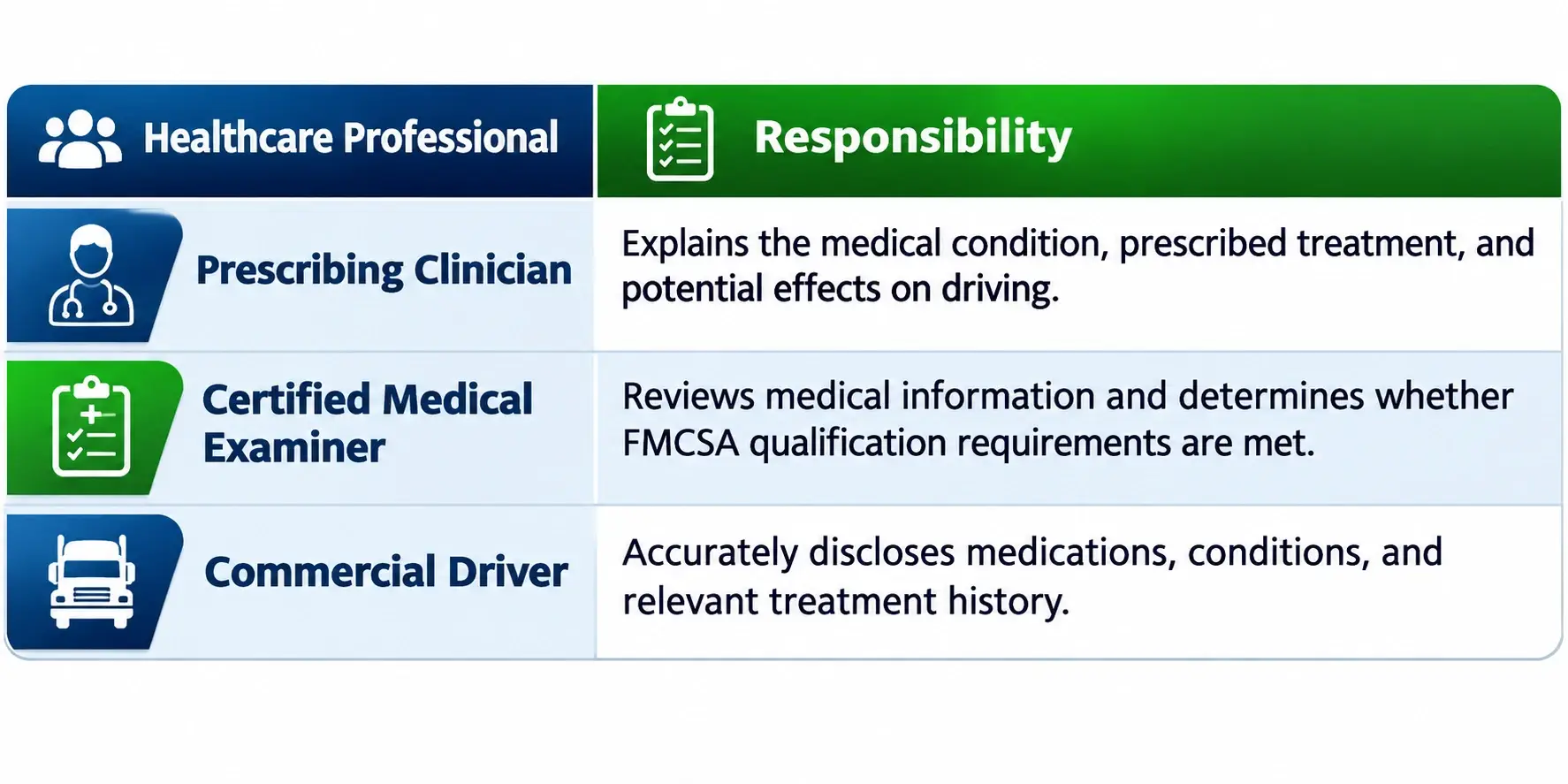
The prescribing clinician provides medical information about the driver’s treatment.
However, the certified medical examiner makes the final physical qualification decision.
Drivers seeking more information about the examination process can review DOT physical requirements for Louisiana CDL drivers.
What Is the MCSA-5895 Medication Form?
The MCSA-5895 medication form, officially called the 391.41 CMV Driver Medication Form, is an optional document that helps medical examiners obtain additional information from a driver’s prescribing healthcare professional.
The form may request:
- Medication names and prescribed dosages
- Medical conditions being treated
- The prescribing professional’s opinion about medication effects on safe driving
- Relevant details needed for the certification assessment
The form does not replace the DOT examination.
According to FMCSA’s official MCSA-5895 guidance, its use is voluntary and determined by the medical examiner.
Not every driver needs this form. The examiner may request it when additional medication information is necessary.
Coordinate With Your Prescribing Healthcare Professional
Before your examination, discuss the medications you take with the healthcare professional managing your treatment.
Explain that you operate a commercial vehicle and ask whether the treatment could affect alertness, judgment, or driving performance.
If your medical examiner requests documentation, your prescribing clinician may provide relevant information about the medication and underlying condition.
The FMCSA Medical Examiner’s Handbook provides additional guidance on reviewing medication use and physical qualification.
Need a DOT medical examination after starting a new prescription? Gulf Coast Occupational Medicine offers DOT physicals and medical examinations for commercial drivers. Contact the clinic to discuss scheduling and ask what supporting documentation may be helpful for your situation.
A Gonzales CDL Driver Starts New Medication
A commercial driver in Gonzales, Louisiana, begins taking a new prescription medication shortly before an upcoming DOT physical.
Because the medication may affect alertness, the driver contacts the prescribing clinician to discuss its potential effects on commercial driving.
Before the examination, the driver prepares a current medication list and relevant treatment information.
During the appointment, the certified medical examiner reviews the prescription and determines whether additional documentation is necessary.
If the examiner requests an MCSA-5895 form, the driver coordinates with the prescribing clinician to provide the requested information.
The examiner then determines whether the driver meets the applicable medical qualification requirements.
This example demonstrates why medication disclosure and clear communication between healthcare professionals are important.
DOT Medical Exam Medication Disclosure: What to Bring
Accurate DOT medical exam medication disclosure helps the examiner understand your treatment and overall medical history.
Before your appointment, prepare:
- A complete list of prescription medications
- Medication names, dosages, and frequency
- Recently started, stopped, or changed prescriptions
- Over-the-counter medications and supplements
- Relevant medical records and treatment information
- Supporting documentation requested by the medical examiner
Drivers should report medications accurately, including prescriptions taken for conditions that may not seem related to driving.
A medication list alone may not resolve every qualification question. The examiner may need information about the treated condition, treatment stability, and possible side effects.
GCOM provides DOT examination services in Baton Rouge and surrounding communities. Review Gulf Coast Occupational Medicine clinic locations to find an appropriate location.
Prescription Medication CDL Physical Checklist
Use this checklist before your next examination.
- Review all current prescriptions.
- Identify recently started or changed medications.
- Discuss driving-related side effects with your prescribing clinician.
- Prepare medication names, dosages, and treatment information.
- Gather relevant medical documentation.
- Ask whether the MCSA-5895 form may be needed.
- Disclose medications and medical conditions accurately.
- Follow the examiner’s instructions for additional documentation.
For commercial driver medical certification, medication safety must be considered alongside the driver’s overall medical qualification.
Frequently Asked Questions
1. Can I pass a CDL physical while taking prescription medication?
Yes, depending on the medication, underlying condition, and applicable qualification standards. An FMCSA-certified medical examiner determines whether you are medically qualified.
2. Is the MCSA-5895 form required for every prescription?
No. The form is optional. The medical examiner may request it when additional information from the prescribing clinician is needed.
3. Will a letter from my prescribing doctor guarantee DOT certification?
No. A prescribing clinician’s opinion may support the evaluation, but the certified medical examiner makes the final qualification decision.
4. Should I stop taking medication before a DOT physical?
Do not discontinue prescribed medication or change your dosage without consulting your treating healthcare professional. Discuss medication concerns and possible driving-related effects with your clinician.
Prepare for Your CDL Physical With Gulf Coast Occupational Medicine
Starting a new prescription does not necessarily prevent you from completing a CDL physical. Accurate medication disclosure and appropriate supporting documentation help the examiner evaluate your medical qualification.
Gulf Coast Occupational Medicine provides DOT physical examinations for commercial drivers throughout Baton Rouge, Gonzales, Geismar, Walker, and surrounding Louisiana communities.
Taking a new prescription and preparing for a DOT examination?
Have your current medication list, relevant medical records, and any requested documentation available.
Call (225) 753-7233 or contact Gulf Coast Occupational Medicine to discuss scheduling a DOT physical and preparing for your examination.
Medical and regulatory note: This article provides general information and does not replace individualized medical advice or FMCSA requirements. Medical qualification decisions are made by certified medical examiners. Drivers should consult their prescribing healthcare professionals about medication changes and potential effects on safe driving.
