
For companies operating in sectors like oil and gas, construction, or forestry, why mobile medical units are ideal for remote worksites comes down to one critical factor: immediate access to professional care in environments where every second counts. When your crew is miles away from the nearest hospital, a mobile clinic isn’t just a convenience it is a vital pillar of your safety infrastructure and operational continuity.
In the high-stakes world of industrial labor, the logistical challenge of transporting an injured or ill worker from a remote location to a city clinic can lead to unnecessary downtime and exacerbated medical conditions. By utilizing mobile medical units, companies can bring the clinic directly to the job site, ensuring that OSHA compliance, drug testing, and emergency first aid are handled on-site without the logistical nightmare of off-site travel.
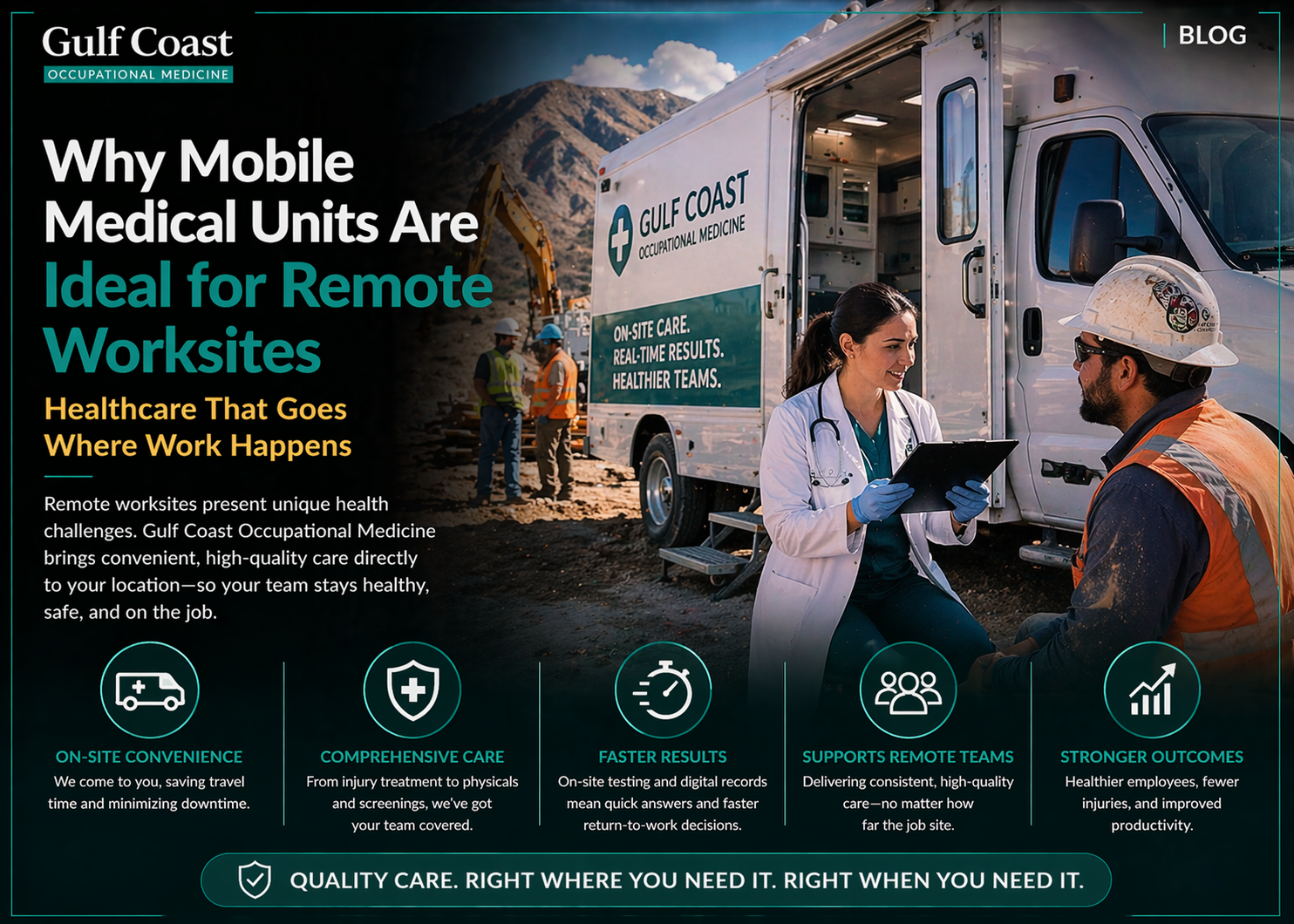
The Logistical Advantage: Eliminating “Windshield Time”
In remote industrial settings, time is the most expensive commodity. When a worker needs a routine physical, a respirator fit test, or a non-emergency medical consultation, sending them to a traditional brick-and-mortar clinic often results in hours of “windshield time.”
This refers to the paid hours spent driving to and from a facility. For a project manager, this means a drop in productivity and potential delays in project milestones. Mobile medical units eliminate this friction. The “clinic” arrives at your gates, services the crew in shifts, and allows workers to return to their posts in a fraction of the time.
Enhanced Emergency Response and Triage
In a remote environment, a minor injury can quickly escalate if professional triage isn’t available. Mobile units are typically outfitted with advanced diagnostic tools, trauma kits, and communication systems that far exceed a standard first-aid station.
-
Immediate Assessment: Having a dedicated medical space allows for a sterile environment to assess lacerations, burns, or cardiac events.
-
Stabilization: If a serious injury occurs, the mobile unit serves as a stabilization point while waiting for aero-medical evacuation or ground transport.
-
Reduced Liability: Professional on-site documentation of an injury can be crucial for workers’ compensation claims and incident reporting.
Comprehensive Occupational Health Services
One common misconception is that mobile units are only for emergencies. In reality, they are fully functional occupational health hubs. For a site supervisor, having these services available on-road is a game-changer for compliance.
1. On-Site Drug and Alcohol Testing
Maintaining a drug-free workplace is mandatory in safety-sensitive industries. Mobile units provide a controlled, private environment for post-accident or random drug screenings. This ensures the integrity of the sample and prevents the “time gap” that occurs when a worker travels to an off-site lab.
2. Audiometric and Respiratory Testing
For workers in high-decibel environments or those exposed to silica and chemicals, regular testing is an OSHA requirement. Mobile units equipped with sound-proof booths and spirometry equipment allow you to test your entire workforce in a single day, ensuring you stay compliant without halting operations.
3. Physicals and Fit-for-Duty Exams
New hires can be onboarded faster when the medical screening happens at the project site. This “one-stop-shop” approach simplifies the HR pipeline significantly.
Better Health Outcomes and Employee Morale
When employees see that their employer has invested in a high-quality medical presence, it sends a powerful message about the company’s culture. Workers feel safer and more valued knowing that professional care is steps away rather than hours away.
Furthermore, mobile units often catch small health issues before they become chronic. A medic on-site might notice a trend in heat exhaustion or repetitive motion strain and provide proactive guidance, preventing a formal OSHA-recordable incident before it happens.
Cost-Effectiveness of On-Site Care
While there is an upfront cost to contracting a mobile medical provider, the Return on Investment (ROI) is substantial. Consider the following cost-saving factors:
-
Reduced Transport Costs: No need for company vehicles or fuel to transport staff for routine tests.
-
Lower Insurance Premiums: Demonstrating a proactive on-site medical presence can often lead to more favorable terms with workers’ comp insurers.
-
Minimized Project Delays: Keeping your “boots on the ground” means the project stays on schedule.
Adapting to the Modern Worksite
Today’s mobile medical units are more advanced than ever. They are climate-controlled, equipped with high-speed satellite internet for telehealth consultations, and designed to operate in rugged terrain. Whether you are managing a pipeline in the rural South or a massive construction site in a developing suburb, these units adapt to your footprint.
They act as a bridge between the job site and the broader healthcare system. Through integrated electronic medical records (EMR), the data collected on-site can be instantly shared with the home office or a specialist, ensuring a seamless continuum of care.
Secure Your Site with Gulf Coast Occupational Medicine
At Gulf Coast Occupational Medicine, we understand that your workforce is your most valuable asset. Our mobile medical solutions are designed to keep your team safe, healthy, and compliant, no matter how remote your location. Don’t let distance dictate the quality of care your employees receive.
Ready to streamline your safety protocols and reduce your company’s downtime? Book your appointment today or call us at +1 (225) 753-7233 to learn how we can bring world-class occupational health directly to your doorstep.
