
Choosing between mobile vs clinic-based occupational health depends entirely on your workforce size, industry hazards, and how much downtime your operations can afford during safety screenings. For many Gulf Coast businesses, the decision isn’t just about medical care—it’s about logistics.
The Evolution of Workplace Wellness
In the fast-paced industrial landscape of the Southern United States, maintaining a healthy workforce is a regulatory necessity and a competitive advantage. Companies today are no longer limited to sending employees to a traditional doctor’s office. High-quality occupational health services have evolved to meet the demands of the modern job site, offering flexibility that was unimaginable a decade ago. Whether you are managing a construction crew in Baton Rouge or a manufacturing plant along the coast, understanding the nuances of service delivery is key to your bottom line.
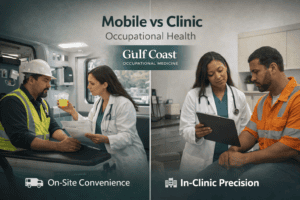
The Case for Clinic-Based Occupational Health
For many businesses, the traditional brick-and-mortar clinic remains the gold standard for comprehensive care. A fixed facility offers a controlled environment designed specifically for medical evaluations.
Advanced Diagnostic Equipment
Clinics are often outfitted with high-end diagnostic tools that are difficult to transport. This includes stationary X-ray machines, advanced pulmonary function testing (PFT) booths, and sophisticated labs for complex screenings. When an employee needs a definitive diagnosis or a specialized fitness-for-duty exam, the clinic provides the most stable environment.
Immediate Access to Specialists
A physical clinic acts as a hub for medical expertise. If a routine physical reveals a deeper issue, the employee is already in a setting where they can be triaged or referred quickly. For non-emergency work injuries, the “walk-in” capability of a clinic ensures that the “wait and see” approach doesn’t turn into a costly long-term disability claim.
Separating Work from Wellness
There is a psychological benefit to the clinic model. When an employee leaves the job site for a physical, they often feel they are receiving more thorough, personalized attention. It also prevents the “assembly line” feel that can sometimes occur during mass on-site screenings.
The Rise of Mobile Occupational Health
On the flip side, mobile occupational health is the “ultimate disruptor” for industries where time is the most expensive commodity. By bringing the clinic to your parking lot, you eliminate the logistical nightmare of scheduling off-site visits.
Eliminating Travel Time and “Windshield Time”
Think about the math: If you send 20 employees to a clinic, and each spends 45 minutes driving and 45 minutes in the waiting room, you’ve lost 30 man-hours before a single test is even performed. Mobile units pull up to your facility, allowing workers to step off the line, complete their testing, and be back at their station in 20 minutes.
Compliance Made Easy
For OSHA-mandated screenings like hearing conservation (audiograms) or respirator fit testing, mobile units are incredibly efficient. You can cycle an entire shift through a mobile unit in a single morning. This ensures 100% compliance in one fell swoop, rather than chasing down individual employees to make sure they went to their appointments.
Minimal Operational Friction
Mobile services are tailored for high-volume needs. If you have a seasonal hiring surge or a major project “shutdown” coming up, mobile units allow you to clear a large volume of workers for duty simultaneously.
Side-by-Side Comparison: Mobile vs. Clinic
To help you decide which path fits your current needs, let’s look at the primary factors:
